Requests for further Evidence, commonly known as RFEs are another obstacle in obtaining an approval across almost all immigration petitions, especially in the context of H-1Bs.
Now that final selections have been made under the H-1B lottery, employers will be filing cap- subject petitions over the next 3 months (April 1 through June 30). During this time, we expect to see a lot of RFEs and one area which appears ripe for these will focus on whether or not the H-1B has been selected under the correct wage level. Entry level positions are likely to be scrutinized more than ever.
The new I-129 form now requires employers to list the requirements for the position including the following:
- Level of education;
- Number of years experience required to qualify for the position;
- Special skills required; and
- How many people the beneficiary will supervise and their position titles.
Previously employers could simply state that the position required at least a bachelor’s degree, without specifying the number of years of experience required etc. However, by requiring employers to provide more specifics USCIS will now have more ammunition to challenge wage levels and therefore it is not more important than ever that employers understand how many levels are calculated.
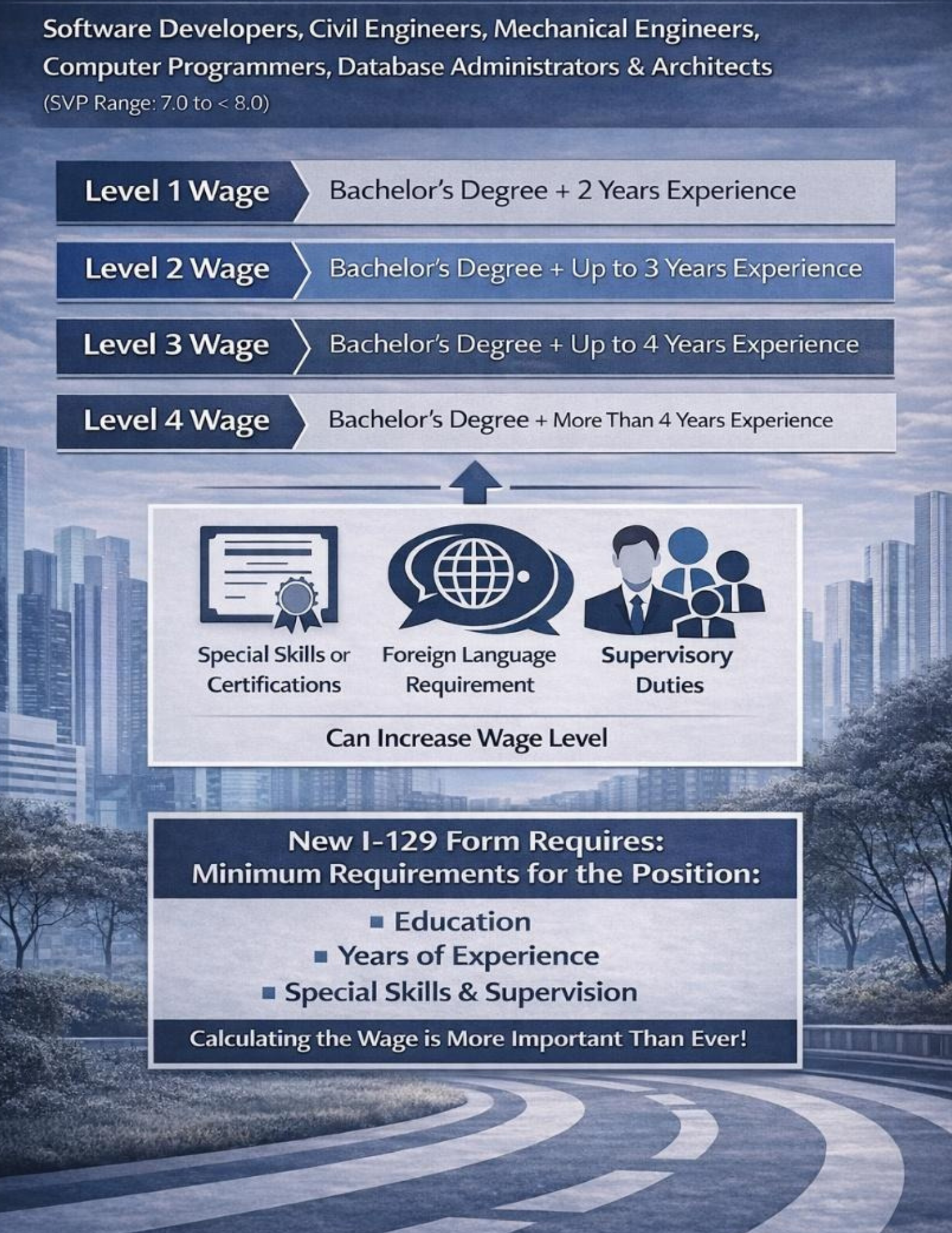
In order to determine the correct wage employers should refer to the prevailing wage guidance from 2009 and compare the requirements for the position to ONET requirements.
Positions that require several years of experience, special skills and/or supervision cannot be filed under a level I or level II wage. Certifications and foreign language requirements may also increase the wage level.
Does wage level need to match the H-1B registration?
Not necessarily.
Under the new weighted H-1B selection system, higher offered wages received more entries in the lottery. USCIS compared the offered salary to prevailing wage levels (e.g., Level II, III, IV) to determine how many chances a beneficiary received.
However, that registration-stage classification does not lock you into that wage level for the LCA or H-1B petition.
The wage level for the LCA and petition must be determined independently, based on the actual position requirements, specifically the minimum education, experience, special skills and supervision.
For example, a candidate may have received three entries because the offered wage aligned with a Level III wage. But if the role itself only requires a bachelor’s degree and one year of experience, that position may properly fall under Level I. In that case, the LCA and H-1B should be filed at Level I, not Level III.
Conclusion
The shift to a weighted lottery, combined with the expanded disclosures on the new Form I-129, gives USCIS a much clearer framework to scrutinize whether the wage level truly aligns with the position.
The takeaway is straightforward: consistency and defensibility matter more than ever. Employers should not anchor wage level decisions to the registration stage but instead ground them in a well-documented analysis of the role itself—education, experience, duties, and level of responsibility, supported by O*NET and prevailing wage guidance.
If the requirements point to a higher wage level, file accordingly. If they support a lower level, ensure the record clearly justifies it. Either way, mismatches between job requirements and wage level will be an easy trigger for RFEs.
If you have questions regarding the above, please contact Chris Prescott at cprescott@psbplaw.com.