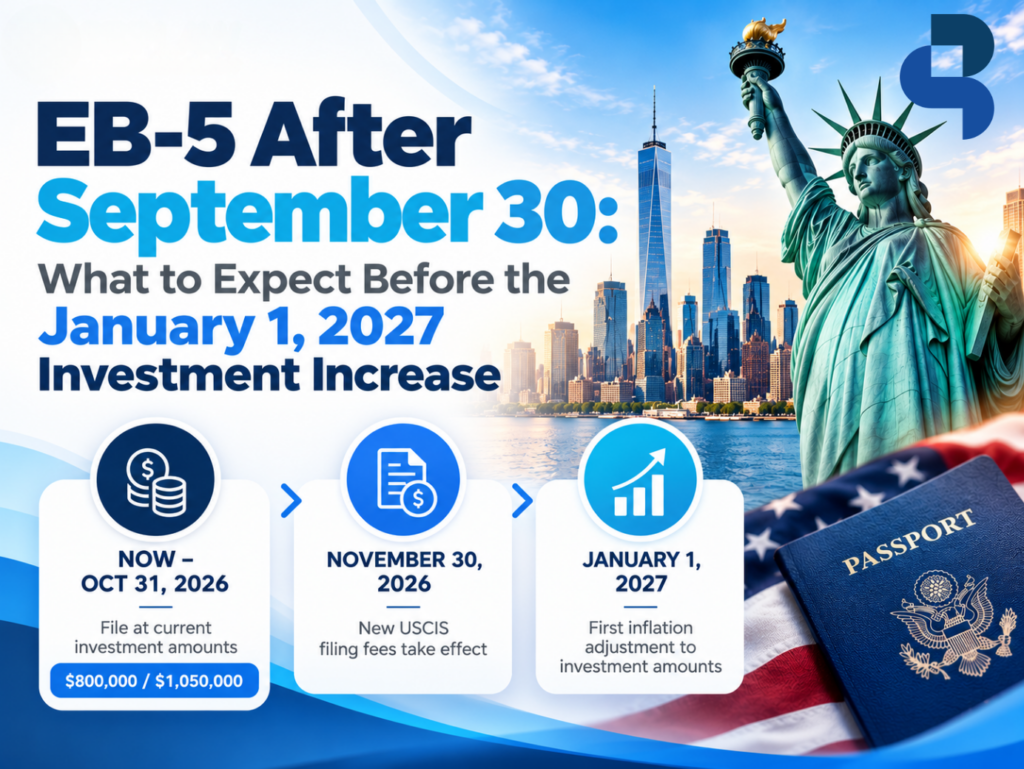
The September 30, 2026, grandfathering deadline has passed, but the EB-5 calendar is not quiet. Two more dates will shape what an EB-5 investment costs: new USCIS filing fees on November 30, 2026, and the first inflation adjustment to the minimum investment amounts on January 1, 2027.
For investors who have not yet filed, the window to file at today’s $800,000 and $1,050,000 thresholds is now measured in weeks. Here is what we expect between now and the end of the year, and what remains uncertain.
Where things stand after September 30
The Regional Center Program did not end on September 30. Under the EB-5 Reform and Integrity Act of 2022 (RIA), it remains authorized through September 30, 2027, and USCIS continues to accept Form I-526E petitions.
What changed is protection. Regional center petitions filed on or before September 30, 2026 are grandfathered: if the program later lapses, USCIS cannot stop processing them because of that lapse. Petitions filed on or after October 1, 2026 do not carry that statutory shield.
As of mid-October 2026, Congress has not extended the grandfathering date or reauthorized the program beyond September 30, 2027. Investors filing now should weigh that reauthorization risk alongside the cost changes below. Standalone (direct) EB-5 investments under Form I-526 are permanently authorized and are not affected by the sunset.
November 30, 2026: new filing fees take effect
USCIS has finalized a new EB-5 fee schedule that applies to filings postmarked or filed on or after November 30, 2026. The investor petition fee roughly doubles.
| Form | Fee Before Nov. 30 | Fee From Nov. 30 |
|---|---|---|
| I-526E (regional center investor) | $3,675 | $7,850 |
| I-526 (standalone investor) | $3,675 | $7,615 |
| I-829 (removal of conditions) | $3,750 | $5,000 |
| I-526E Integrity Fund fee | $1,000 | $1,100 |
The new I-526 and I-526E amounts include a $75 technology fee. Regional centers also face steep increases on Forms I-956 and I-956F. For the full schedule, see our earlier article, EB-5 Filing Fees to Increase November 30, 2026.
An investor who files before November 30 saves about $4,000 on the petition fee. That saving matters, but it is small next to the investment increase that follows on January 1.
January 1, 2027: the first inflation adjustment
The RIA set the standard minimum investment at $1,050,000 and the targeted employment area (TEA) and infrastructure minimum at $800,000. It also built in an automatic adjustment every five years, starting January 1, 2027, for petitions filed on or after that date (INA § 203(b)(5)(C)(iii)).
The statutory formula has three steps:
-
Increase the $1,050,000 standard amount by the cumulative change in the Consumer Price Index for All Urban Consumers (CPI-U) since January 1, 2022.
-
Round the result down to the nearest $50,000.
-
Set the TEA and infrastructure amount at 75 percent of the adjusted standard amount.
No new legislation is needed. DHS publishes the adjusted amounts through a technical amendment in the Federal Register. As of this writing, USCIS has not published the final figures.
What the new amounts could be
The increase is certain; the exact figure is not. Earlier this year, we and much of the industry projected a TEA minimum of $937,500. Two recent USCIS publications have made the calculation less clear.
First, the July 2, 2026 proposed rule states in its preamble that the 75 percent TEA figure would itself be rounded down to the nearest $50,000. The proposed regulatory text does not say that. A second round-down may turn $937,500 into $900,000 or $950,000.
Second, the statute uses the phrase “cumulative annual percentage change” in the CPI-U. In its September 30, 2026 fee rule, USCIS adjusted the Integrity Fund fee by comparing annual CPI-U averages rather than a start and end month. If USCIS reads the investment provision the same way, the increase would be smaller.
Industry analysis published by Peachtree Group in October 2026 lays out the possible outcomes:
| CPI-U Method | Cumulative Increase | Standard Amount | TEA / Infrastructure Amount |
|---|---|---|---|
| Start and end index (Dec. 2021 to Aug. 2026) | 20.1% | $1,250,000 | $937,500, or $900,000 with a second round-down |
| Half-year averages | 14.7% | $1,200,000 | $900,000 |
| June-to-June | 12.7% | $1,150,000 | $862,500 or $850,000 |
| Annual averages | 10.0% | $1,150,000 | $862,500 or $850,000 |
Whatever method USCIS adopts, the TEA minimum will rise by at least $50,000 and as much as $137,500 per investor. Many in the industry expect it will not fall below $900,000.
The proposed rule and a possible $1.4 million tier
On July 2, 2026, DHS published a proposed rule to implement the RIA (Docket USCIS-2026-0100). The comment period closed August 31, 2026. Nothing in it has taken effect.
The headline proposal is a new “high employment area” tier with a $1,400,000 minimum. It would cover parts of metropolitan areas outside any TEA where unemployment is well below the national average. The proposal would sit alongside the January 1 inflation adjustment, not replace it.
The proposed rule also says DHS will decide at the final-rule stage whether to include the adjusted 2027 amounts. A final rule could arrive before or after January 1, and it may differ from the proposal. We are watching the Federal Register closely.
Why the filing date matters
The adjusted amounts apply to petitions filed on or after January 1, 2027. A petition filed before that date is governed by the current $800,000 and $1,050,000 thresholds. What counts is when USCIS receives a properly filed petition, not when funds reach escrow or when subscription documents are signed.
That leaves little room for error. A petition rejected for a missing signature, a wrong fee, or an incomplete form is not “filed,” and refiling in January means the higher amount. Holiday closures and courier delays in late December add further risk.
We recommend treating mid-December, not December 31, as the practical deadline. Investors who also want the lower filing fees should aim to file before November 30.
What investors should do now
The next ten weeks reward preparation, not haste. A rushed petition with gaps in source of funds documentation can lead to a Request for Evidence or denial, which costs far more than any fee or threshold difference.
-
Start source of funds work now. Tracing the lawful source and path of every dollar is usually the longest part of the filing.
-
Finish project due diligence. Review the offering documents, TEA or infrastructure basis, and regional center compliance history before committing.
-
Decide on regional center versus direct. Post-September 30 regional center filings are not grandfathered; direct EB-5 is not exposed to the 2027 sunset.
-
Work backward from the deadline. Target November 30 for the lower fees and mid-December at the latest for the current investment amounts.
-
Watch for the Federal Register notice. The official 2027 figures may be published close to, or even after, January 1.
If you are considering an EB-5 investment, our immigration team can help you assess your timeline and prepare a complete filing. Schedule Your Consultation.
For questions about EB-5 eligibility or how these changes may affect your case, please email Venkat Abhijith Thumma at vthumma@psbplaw.com.
This article is for general information only and is not legal advice. Investment amounts and filing rules remain subject to official USCIS publication.