Last October I wrote about the Supreme Court declining to hear Save Jobs USA v. DHS, and I said at the time that the decision did nothing to stop a future administration from revisiting the program through new regulatory action. That is exactly what is now happening.
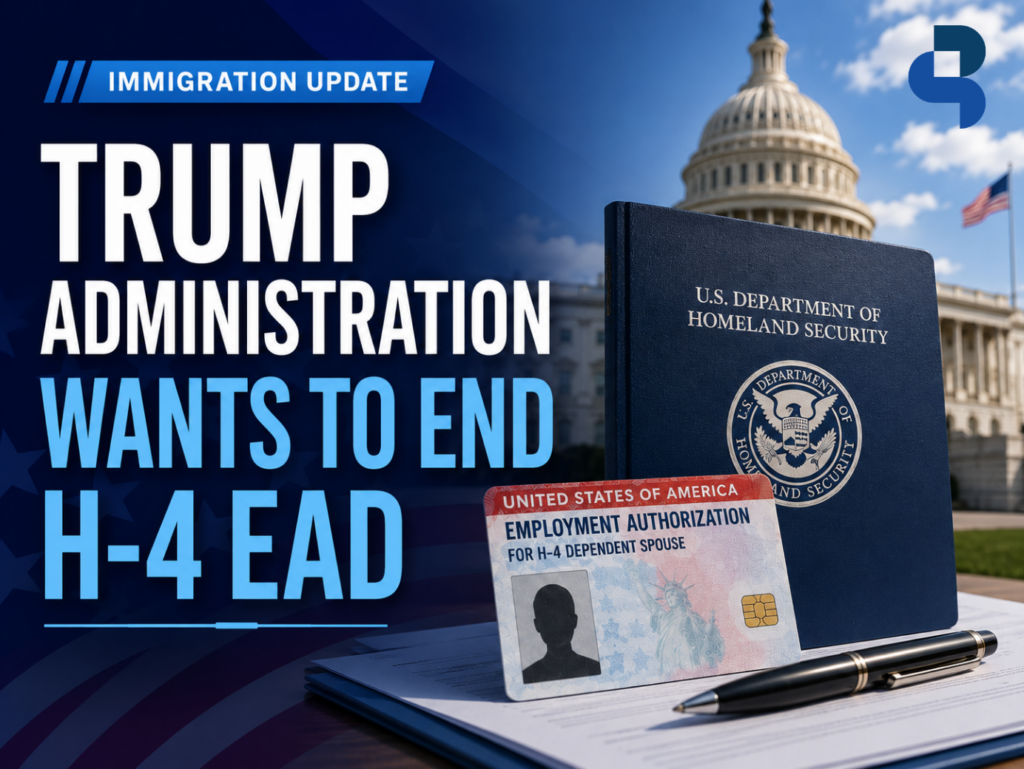
DHS has placed a rule on the Unified Agenda titled “Removing H-4 Dependent Spouses From the Classes of Noncitizens Eligible for Employment Authorization” (RIN 1615-AD14).
Nothing has changed yet
No H-4 EAD has been revoked. No rule has been proposed, no comment period is open, and there is nothing for you to respond to. The rule is listed as a long-term action with a proposed rule date of “To Be Determined.”
That is a statement of intent, not a deadline. It is a serious one, and the last time this administration made it the rule got within one signature of publication. But it is not a rule yet, and you should not be making decisions as though it is.
What the rule would do
Since 2015, certain H-4 spouses have been able to apply for an EAD. This has never been available to every H-4 spouse. You qualify if your H-1B spouse has an approved I-140, or if your spouse has been granted H-1B time beyond the six-year limit under AC21, which in practice means a labor certification or I-140 was filed at least a year before the seventh year started.
The proposed rule would delete that category outright. In DHS’s own words, it would “restore DHS’s long-standing policy of not extending eligibility to request employment authorization to H-4 dependent spouses.”
We have been here before
DHS proposed the same rescission in the first Trump administration. That rule went to OMB for review in February 2019 and then sat there for nearly two years without ever being published. It was withdrawn in January 2021 and abandoned.
The Supreme Court did not save the H-4 EAD
This is where I think a lot of people took away the wrong message last year. When the Court declined to hear Save Jobs USA, the coverage treated it as the end of the fight. It was not. What the D.C. Circuit decided, and what the Supreme Court left in place, is that DHS has the authority to decide which classes of nonimmigrants can work. That cuts both ways. If DHS has the authority to create this benefit by regulation, it has the authority to take it away by regulation. The litigation did not protect the H-4 EAD. It confirmed that the rule is DHS’s to change.
How fast could this move
A long-term action means the agency does not expect to act on it within the next twelve months. That is DHS’s own signal, and it should take some of the heat out of the headlines you are reading. It is not a guarantee though, an agency can move a rule off the long-term list and publish whenever it wants.
If it does move, this still takes time. DHS has to publish a proposed rule, most likely with a 30-to-60-day comment period. It then has to review the comments and publish a final rule, which realistically takes several months. Then there is an effective date, and then there is litigation.
The strongest challenge would not be about DHS’s authority, because that question has now been answered. It would be about whether DHS gave a reasoned explanation for reversing a ten-year-old policy and properly accounted for the people who relied onnc it. Families have taken out mortgages on two incomes. Employers have staffed roles. Careers have been built on this EAD since 2015. An agey cannot simply ignore that, and if it does, that is what a court will look at.
What happens to EADs already issued
Whether a final rule would revoke cards already in hand or let them run to their expiration date is the most important consideration and it is the first thing I would look for. The 2019 draft was never made public, so we have no idea what DHS intends.
Something that is already hurting people
While everyone is watching the agenda, the rule I wrote about last October is already causing real problems. For renewal applications filed on or after October 30, 2025, DHS eliminated the automatic extension of employment authorization. That extension used to bridge the gap between filing a timely renewal and getting the approval.
That cushion is gone. If your renewal is not approved before your current card expires, you stop working.
What I would do now
File your renewal at the earliest date you are allowed to, keep your I-140 approval notice and your spouse’s H-1B documents together and current, and treat your expiration date as immovable.
More importantly, find out whether you have your own path. A lot of H-4 EAD holders qualify for something in their own right and have never looked into it, because they never needed to. That might be an H-1B with a cap-exempt employer, registration in the next lottery, an O-1, an EB-2 National Interest Waiver, or L-2 or E-2 dependent status if your spouse’s employer has that option. If your priority date is close to current, adjustment of status changes everything, because that EAD does not depend on H-4 status at all.
Employers should be running a report now on who on the payroll holds an H-4 EAD. You do not want to be asking that question for the first time on the day a rule is published.
My take
Take the agenda entry seriously, and take the “To Be Determined” just as seriously. This administration has told us what it wants to do. It has not told us when, and it did not finish the job the last time it tried. The answer is not to panic over a rule that does not exist, and it is not to ignore it either. It is to remove the single points of failure in your work authorization before someone else forces the issue. I will follow this and update you as it moves.
If you want to talk through where you stand, please contact PSBP Law Partner Chris Prescott at cprescott@psbplaw.com.