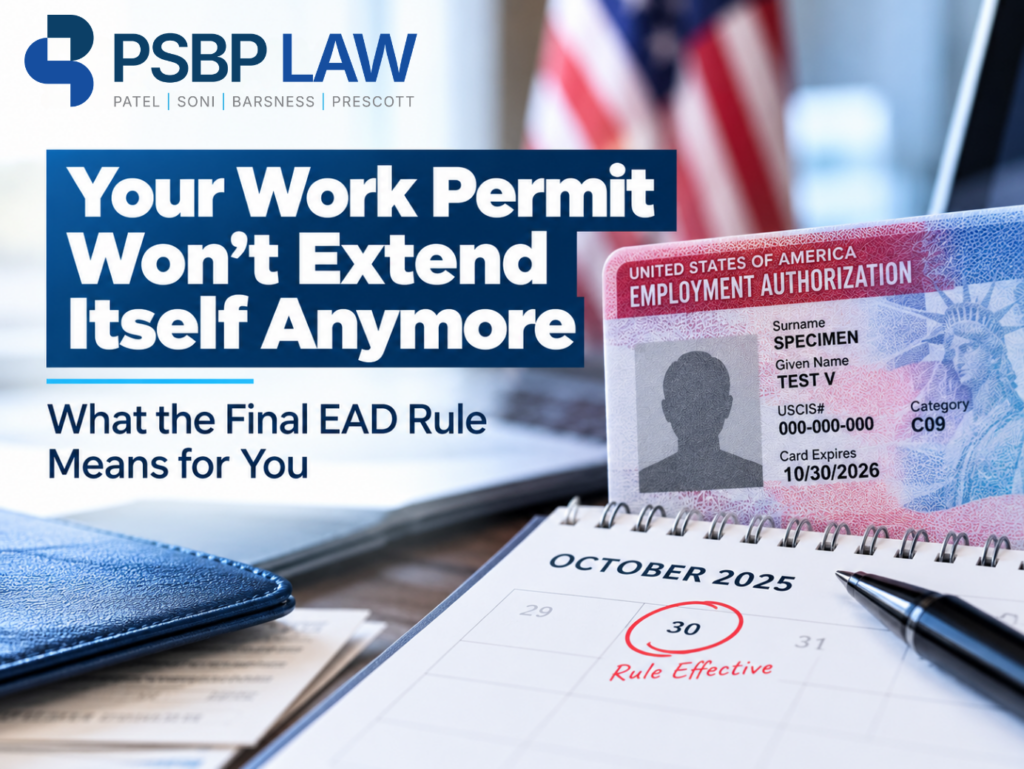
On October 14, 2026, the Department of Homeland Security published a final rule permanently ending the automatic extension of most Employment Authorization Documents (EADs). If your renewal is still pending when your card expires, you may have to stop working until USCIS approves it.
Here is what changed, who is affected, and what you can do now to protect your job.
| What changed | Filing a renewal work permit application no longer extends your current card past its expiration date. |
| Who is affected | Most EAD holders who filed (or will file) a renewal on or after October 30, 2025, including many adjustment applicants, asylum applicants, and H-4 spouses. |
| When | In effect from October 30, 2025; made final on October 14, 2026. |
| What to do | Check your card’s expiration date now and file your renewal as early as allowed (up to 180 days before it expires). |
What Changed
Under the prior rule, people in certain categories who filed a timely renewal application received an automatic extension of up to 540 days beyond the expiration date on their card. That extension covered months and sometimes more than a year while USCIS processed the application.
DHS ended that practice through an interim rule that took effect on October 30, 2025. The October 14, 2026 final rule adopts that interim rule without any changes. The result:
- Renewals filed on or after October 30, 2025 do not receive an automatic extension. Your permission to work generally ends on the expiration date printed on your card, unless USCIS approves your renewal first or you have a separate basis to work.
- Renewals filed before October 30, 2025 keep the automatic extension they already qualified for.
- Receipt notices issued after the change no longer describe an automatic extension, and USCIS states they are not proof of work authorization.
DHS’s own analysis estimates that roughly 20,000 to 33,000 work permits may lapse during an 18-month period beginning in May 2027, affecting an estimated 1,700 to 2,800 employers.
Who Is Affected
The change applies broadly to EAD renewals in categories that previously qualified for the automatic extension. Among the groups most likely to feel it:
- Green card applicants with a pending Form I-485 who work on a (c)(9) EAD
- Asylum applicants with a pending asylum case who work on a (c)(8) EAD
- H-4 spouses of H-1B workers who hold a (c)(26) EAD
- Others who renew a work permit in a category that previously received the automatic extension
Who Is Not Affected
- Temporary Protected Status (TPS) holders. TPS-related extensions announced by law or in Federal Register notices are not affected by this rule. Note, however, that a separate 2025 law limits TPS work permits to one year or the length of the TPS designation, whichever is shorter.
- F-1 students on STEM OPT. The separate 180-day extension for students who timely file for a STEM OPT extension is governed by different regulations and remains in place.
- People whose work authorization comes from their status itself, such as H-1B, L-1, and E workers, and L-2 and E spouses whose work authorization is tied to their status. For them, the EAD card is not the only source of permission to work, though their authorization still ends when their status does.
If you are unsure which group you fall into, this is the right time to ask. The answer depends on your specific category and history.
What You Should Do Now
- Check the expiration date on your EAD today.
- File your renewal early.
- Find out whether you have another basis to work. Some people are authorized to work through their status or have another filing option available. An attorney can review whether that applies to you.
- Plan for a possible gap. If your renewal is still pending close to your expiration date, talk with your employer and your attorney early about next steps rather than waiting.
- Do not keep working on an expired card unless you are certain you are covered by an exception. Working without authorization can create serious problems for a pending green card or other application.
A Note for Employers
Employers can no longer accept an expired EAD together with a renewal receipt notice for renewals filed on or after October 30, 2025. Form I-9 reverification rules have not changed, but the practical effect has: an employee whose renewal is still pending at expiration may have to be taken off the schedule until a new card arrives. We recommend that employers review EAD expiration dates across their workforce now, encourage affected employees to file at the start of the 180-day window, and update internal I-9 procedures to reflect the rule.
Questions?
Please contact Attorney Natalia Meade at nmeade@psbplaw.com
This article is for general information only and is not legal advice. Reading it does not create an attorney-client relationship. Immigration rules change frequently; consult an attorney about your specific situation.