The Department of Labor (DOL) has quietly taken a significant step that could reshape the economics of employment-based immigration. A new proposal to revise wage rules across the H-1B, PERM, and related visa programs has been sent again to the Office of Management and Budget (OMB) for review.
Why This Matters
This is the second time this year that DOL has advanced a wage rule to OMB. An earlier version cleared OMB review in February and was expected to be published, but DOL then withdrew it, revised it, and resubmitted it.
The text of the new rule appears here.
If implemented, the new rule could materially change wage obligations for:
- H-1B
- H-1B1
- E-3
- PERMs for EB-2 and EB-3.
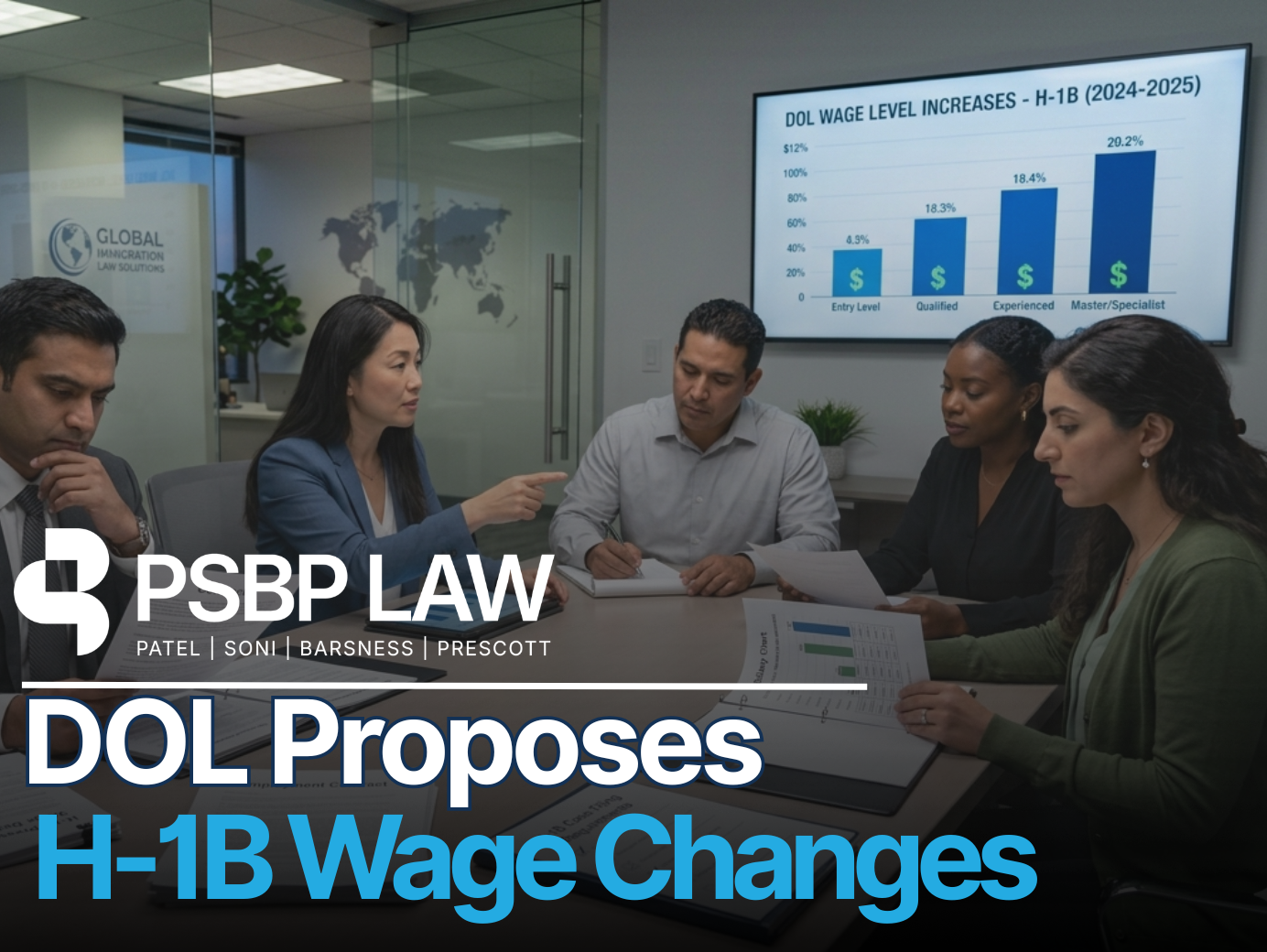
What’s Coming
DOL’s stated goal is to better align prevailing wages with what similarly employed U.S. workers actually earn, and to reduce any perceived wage arbitrage in hiring foreign nationals. The rule is now published, with a 60-day public comment period underway.
Current framework (OEWS-based):
• Level I (entry): 17th percentile
• Level II (qualified): 34th percentile
• Level III (experienced): 50th percentile
• Level IV (fully competent): 67th percentile
Proposed shift:
Using Occupational Employment and Wage Statistics data, DOL proposes:
• Level I → 34th percentile
• Level II → 52nd percentile
• Level III → 70th percentile
• Level IV → 88th percentile
This is not a marginal adjustment, it’s a structural reset of the wage floor. If implemented, it will push wages up across all four levels, compress the gap between levels, and make entry-level and mid-level sponsorship significantly more expensive. For many employers, especially smaller companies, this will directly impact hiring strategy, role structuring, and long-term sponsorship viability.
Practical Impact for Employers
If a strengthened wage rule employers should be prepared for:
- Higher salary floors for sponsorship
- Employers would need to ensure that offered wages meet higher prevailing wage benchmarks for H-1B, H-1B1, E-3, and PERM.
- Increased difficulty supporting Level 1 and Level 2 wages
- Expect closer scrutiny of whether “entry-level” classifications are consistent with required education and experience, especially for roles that in practice demand advanced degrees or specialized skills.
- Tighter alignment between job duties, minimum requirements, and pay
- For both H-1B (LCA/PWD) and PERM, the job description and minimum requirements will need to fit the wage level in a way that withstands audit or challenge.
What Happens Next
The proposal is within a 60-day public comment period starting March 26, 2026. After reviewing feedback, DOL may revise and finalize the rule, but based on prior attempts, employers should not assume there will be much flexibility or delay in implementation.
Conclusion
DOL takes the position that prevailing wage levels have long been set too low, enabling misuse of programs like the H-1B to access lower-cost foreign labor. Others will see this as a policy move, particularly under the Trump administration, to restrict legal immigration by increasing the cost and complexity of sponsorship.
Either way, the practical impact is clear: wages are likely to rise, and entry-level roles will face heightened scrutiny. Employers need to ensure their minimum requirements support the selected wage level.
If you have questions please reach out to PSBP Law Partner Chris Prescott at cprescott@psbplaw.com.