Scroll through most private fund newsletters this year and you’ll see the same three words used over and over: “evergreen”, “continuation”, and “liquidity.” The headlines make it seem like every sponsor is racing to include a semi liquid option in their strategy. However, most of these articles are written for funds managing billions, not for the emerging fund manager one to four funds into building a track record with less than $150 million in assets under management. As such, the pressure behind the evergreen fund trend is worth understanding to determine whether an evergreen structure actually makes sense for you. The gap between the headlines and your reality is where sponsors often either make the wrong decision or get ahead of managers copying a playbook fit for large public funds.
Why Emerging Fund Managers Feel Pressure to Offer Liquidity
In today’s market, investors are asking harder questions about how they withdraw capital and what their redemption rights are. Additionally, the investor base itself is shifting with more retail investors entering the market combined with family offices and RIAs who are used to evergreen products. Given the demand, it makes sense for emerging fund managers to assume that evergreen structures should be incorporated into the strategy. However, emerging fund managers really need to question whether that actually makes sense for their fund or whether it is a solution better built for someone else’s balance sheet.
Breakdown of Evergreen Fund Structures
Evergreen funds are a perpetual, semi liquid vehicle with no fixed fund term which match fund life to asset life instead of forcing an exit on a fixed timeline. Similarly, evergreen structures solve common fundraising problems since a perpetual vehicle means fund managers won’t be back in the market raising for Fund II before Fund I has proven itself. As such, evergreen funds are perceived as a solid solution to common problems. The downside is that evergreen funds carry costs that hit smaller funds with $150 million or less in assets under management harder than they do for large billion dollar funds. For example, evergreen funds require:
-
Ongoing valuation obligations that scale with the fund’s NAV cycle rather than the fund’s size;
-
Redemption mechanics with carefully structured gates, notice periods, and liquidity mechanics to avoid the risk of a “run on the fund” the first time performance dips; and
-
Legal and administrative infrastructure with tailored subscription mechanics, NAV calculation methodology, and side letter management across a rolling investor base.
For funds with $2 billion in assets under management, this overhead is easily mitigated, but at $80 million it can meaningfully erode distributions and fee revenue. Due to the amount of extra costs involved, an evergreen fund is often not the right first move.
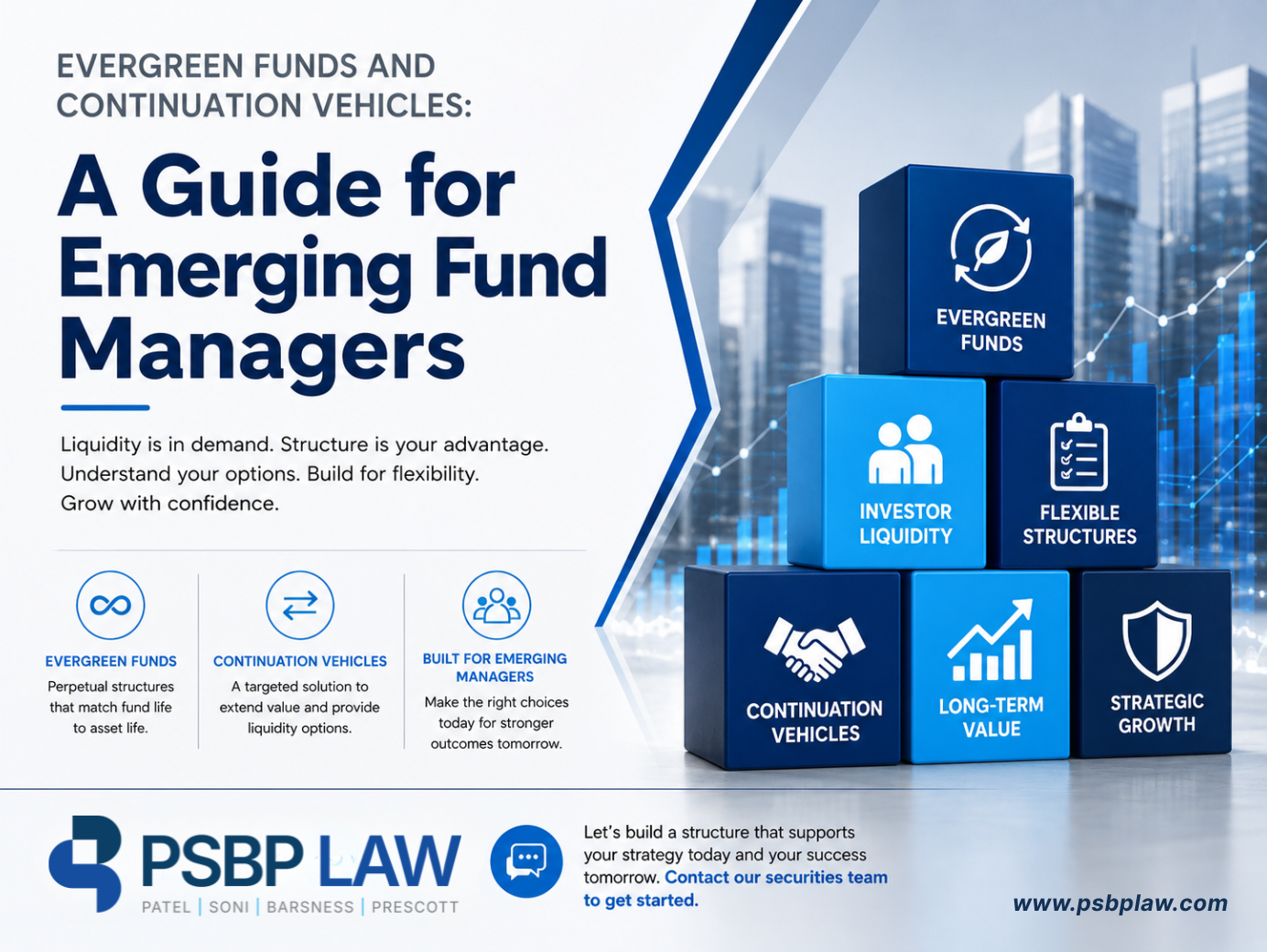
Continuation Vehicles as a Potential Alternative to Evergreen Structures
Often, continuation vehicles are a better fit for emerging fund managers as they are typically a lighter lift than structuring an entire fund into a perpetual vehicle. Continuation vehicles are different from evergreen funds in that they are a one-time transaction that moves specific assets out of an expiring fund into a new vehicle, letting the sponsor hold it longer while giving investors a choice to rollover or exit. A well structured continuation vehicle allows the fund manager to hold a strong performing asset longer than the original fund term allows, gives existing investors the option to rollover into the new fund or cash out, and bring in new capital without restructuring the rest of the portfolio.
However, for fund managers wanting to pursue this route, it is imperative that the original fund documents have continuation vehicle mechanics built in. By the time initial funds reach their term, many emerging fund managers realize the conflicts of interest provisions, valuation mechanics, and consent thresholds all need renegotiation and passive investors have no obligation to agree. With the sponsor sitting on both sides of the deal in setting the asset’s value and selecting who buys it, securities regulators are dedicating more attention to GP led secondaries and continuation vehicle transactions. Three things help keep continuation vehicle transactions from becoming an SEC exam finding or an investor dispute:
- Independent, third party valuations of the asset moving into the new vehicle;
- A genuine alternative for investors who do not want to roll into the continuation vehicle; and
- Clean, upfront disclosure of the sponsor’s conflict of interest.
How Emerging Fund Managers Should Prepare Now
Emerging fund managers do not need to launch an evergreen fund tomorrow, and should instead ensure the next fund’s governing documents to leave the option open. This means building continuation vehicle mechanics into the operating agreement or limited partnership agreement, setting valuation and conflicts protocols within the fund documents themselves, and talking to largest investors about the liquidity terms they would want instead of making assumptions.
If you’re working through your next fund’s structure right now, or you’re not sure your current structure would support a continuation vehicle when the moment comes, let’s find out before you need the answer. Reach out to our securities team to discuss, as a focused review of your governing documents now is a far easier conversation than the one you’d have mid renegotiation.