A rule effective January 17, 2025, changed what’s possible for entrepreneurs and business owners pursuing an H-1B visa. It allows H-1B beneficiaries to self-petition even when they hold a controlling interest in the petitioning entity. For founders and beneficiary-owned businesses, that opened a real path forward.
But this path comes with specific documentation requirements. This article isn’t a general overview of H-1B law. It’s a practical checklist of the documents you should start gathering if you’re considering an H-1B self-petition.
Document requirements can vary based on your individual circumstances. This checklist is for general informational purposes and isn’t a substitute for advice from an immigration attorney.
What Is an H-1B Self-Petition?
An H-1B self-petition allows a beneficiary to sponsor their own H-1B visa through a company they own or control, rather than relying on an unrelated employer to file on their behalf.
One detail worth understanding upfront: when the beneficiary has a controlling interest in the petitioning entity, the initial approval and first extension will be limited to 18 months, instead of the typical three years. Later extensions can be granted for up to three years once eligibility is established.
Who May Benefit From an H-1B Self-Petition?
This pathway may be worth exploring if you:
- Have a business idea and want to establish your own U.S. company
- Are an entrepreneur building a business based on your skills or expertise
- Plan to create a startup that can employ you in a qualifying H-1B position
- Want to pursue H-1B status through a business you own and control
The key is that you would be establishing your own U.S. business, rather than seeking sponsorship from an unrelated employer.
H-1B Self-Petition Document Checklist
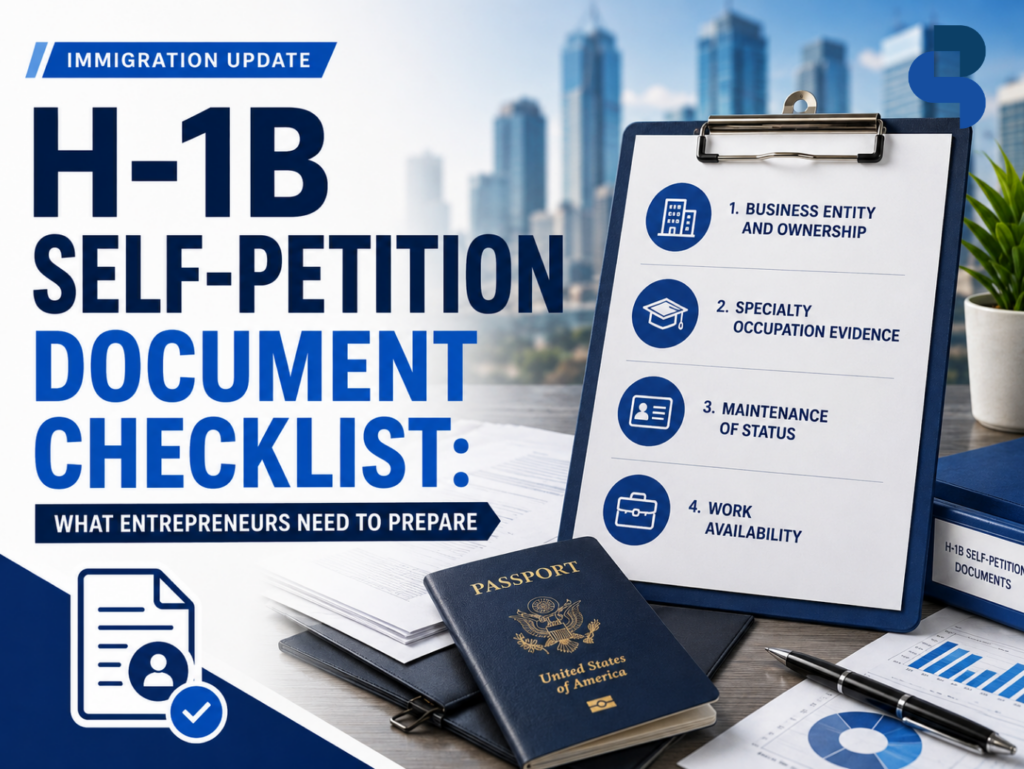
The checklist below is organized into four main categories: business entity and ownership, specialty occupation evidence, maintenance of status, and work availability.
1. Business Entity and Ownership
These documents establish that your business is real, properly structured, and that your ownership stake is clearly documented.
- Formation, management, and ownership documents. These should clearly show your ownership percentage or voting rights in the petitioning entity.
- Copy of the company’s IRS Notice.
- Tax returns for the past two to three years, if applicable.
- Organizational chart showing your position and listing, by name and title, any employees you manage.
- Business plan outlining company goals, operations, and financial projections.
- Business brochures and promotional materials for your products or services.
- Evidence of assets and/or equipment purchases.
- Evidence of a company bank account.
- Business lease agreement and photographs of your office space.
- Employee handbook.
Home Office Documents, If Applicable
If you plan to operate from a home office, additional documents apply:
- A narrative explaining how the business operates from home, including daily operations and how the home environment supports the work.
- A statement on future plans for a commercial lease, if applicable, including timelines and potential locations.
- Workspace photographs showing a professional, organized environment.
- A home business permit, where required by local regulations.
2. Specialty Occupation Evidence
This category shows that your role qualifies as a specialty occupation, meaning it requires at least a bachelor’s degree in a specific field.
- Detailed job description. This should show that you’ll spend most of your time on specialty occupation duties. At least 51% of your duties should relate directly to your degree, with the remainder involving running the business.
- Resume.
- Educational credentials, including degrees, transcripts, experience letters, and certificates.
- Education evaluation, if you hold a foreign degree.
3. Maintenance of Status
These documents confirm your current immigration status.
- I-94, passport, and U.S. visas.
- USCIS approval notices.
- F-1 students only: all I-20s and EAD cards (front and back).
- Last two paystubs and most recent W-2.
4. Work Availability
This category demonstrates that real, specialized work exists for you to perform.
- Client contracts. Executed contracts outlining the scope, duration, and terms of the work.
- Letters of intent. From prospective clients, detailing the anticipated business relationship and start dates.
- Internal project documentation. Project plans, timelines, and descriptions showing the work requires your specialized skills.
- Evidence of funding. Bank statements showing available funds or lines of credit.
- Proof of grants or financial awards from government or private sources.
Why Each Category of Evidence Matters
Each category answers a different question USCIS is trying to verify: Is this a legitimate business? Does the role genuinely require specialized expertise? Is the beneficiary maintaining lawful status? And is there real, available work to justify the petition? Gaps in any one category can weaken an otherwise strong filing.
Tips for Organizing Your H-1B Self-Petition Documents
- Start with the documents that take the longest to prepare, like your business plan and financial records.
- Keep documents organized by category, matching the checklist above.
- Flag which documents are conditional to your situation, such as home office materials, F-1 records, or foreign degree evaluations.
Final Takeaway
A complete, well-organized filing gives your H-1B self-petition the best chance of a smooth review. Gathering these documents early, and understanding why each category matters, puts you in a stronger position from the start.
Next Steps
Every business and every beneficiary’s circumstances are different. If you’re considering an H-1B self-petition, consult with an experienced immigration attorney about the specific documents your case requires.
Have questions about your H-1B self-petition? Contact Chris Prescott, Partner at PSBP Law, at cprescott@psbplaw.com or 972-945-8532.