Whether you are petitioning for an internationally recognized artist under O-1B or for the essential support personnel who make that artist’s work possible under O-2, one phrase tends to appear at the center of nearly every Request for Evidence (RFE): critical role.
For O-2 petitions in particular, proving that a foreign national plays a critical role, and possesses skills that a U.S. worker simply cannot replicate, is one of the most challenging and frequently contested elements of the entire process.
This post breaks down what “critical role” means in both O-1 and O-2 contexts, why O-2 RFEs focused on special skills are increasingly common, and how to build an evidentiary record strong enough to withstand USCIS scrutiny.
What Does “Critical Role” Mean Under the O Visa Framework?
For O-1 petitioners, a critical role is one component of a broader extraordinary ability or achievement standard. USCIS looks at whether the beneficiary has performed in a leading or critical role for organizations or productions with distinguished reputations. Evidence typically includes employer letters, contracts, and reviews that establish the beneficiary’s prominence within their field.
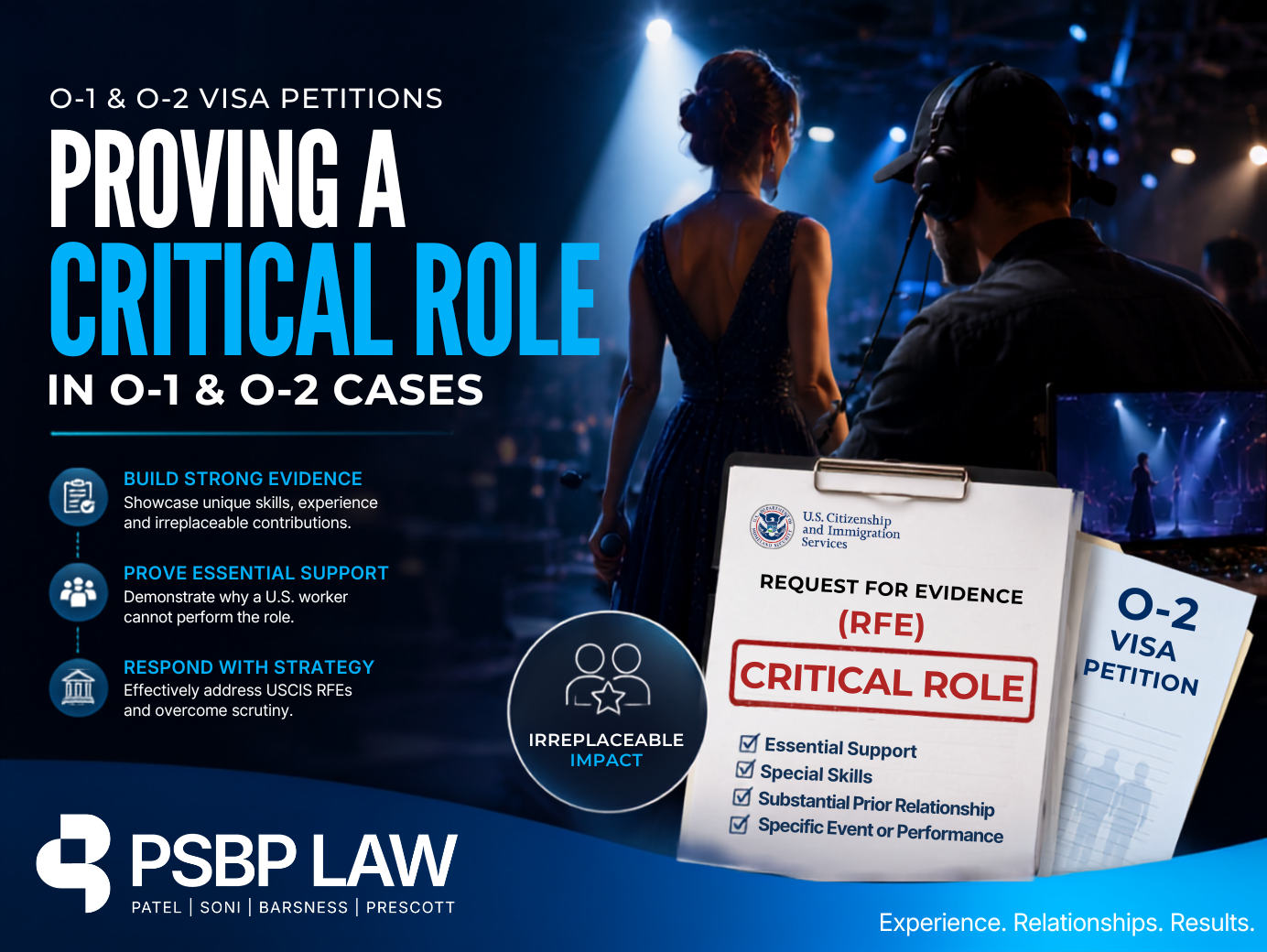
For O-2 petitioners, the standard is different and more demanding in a specific way. An O-2 visa is reserved for aliens who will accompany an O-1 artist or athlete to assist in a specific event or performance. The regulations require that the O-2 beneficiary:
- Provide essential support to the O-1 principal alien;
- Have critical skills and experience with that O-1 alien that are not of a general nature and are not skills that a U.S. worker could perform; and
- Have a substantial prior working relationship with the O-1 alien.
That second element, skills a U.S. worker could not perform, is where most RFEs land.
Why O-2 RFEs About “Special Skills” Are on the Rise
USCIS adjudicators are increasingly skeptical of O-2 petitions that describe support roles in general terms. An RFE may argue that the duties listed are generic occupational titles that any qualified U.S. worker in the industry could fill.
The O-2 classification was not designed as a general work visa. It was designed for individuals whose specific skill set is so intertwined with a particular O-1 principal’s artistic vision, technical requirements, or performance method that substituting a U.S. worker would materially alter or compromise the production.
When your office receives an RFE on this ground, it is an opportunity to reframe the narrative around the specific, individualized nature of the support being provided.
Building the Record: Key Evidence for O-2 “Special Skills” RFEs
- Document the Specific, Non-Transferable Skill Set
The response should describe in granular detail what the beneficiary does that is unique to this O-1 principal’s work. Ask your client and the O-1 principal questions like:
- Has this person developed proprietary techniques, custom equipment setups, or specialized workflows exclusively for this production or artist?
- Would onboarding a new U.S. worker require months of training specific to this production?
- Are there technical specifications, safety protocols, or artistic processes that exist only within this production and that the beneficiary helped develop?
The answers to these questions form the foundation of your narrative.
- Obtain a Detailed Letter from the O-1 Principal
The O-1 principal’s support letter is a powerful piece of evidence. It should specifically address:
- The history of the working relationship and how long the beneficiary has worked with the principal;
- What the beneficiary does that is unique to this production or artistic process;
- Why a U.S. worker, even a highly skilled one, could not step into this role without significant disruption;
- Specific incidents or examples that illustrate the beneficiary’s irreplaceable contributions.
Concrete examples are key.
- Address the U.S. Worker Availability Argument Head-On
Address it directly by explaining that the issue is not the availability of U.S. workers with general skills, it is the absence of U.S. workers who have the specific experiential knowledge built through years of collaboration with this particular O-1 principal.
- Provide Expert Opinion Letters When Appropriate
In complex productions or technical fields, including a letter from an industry expert like a production designer, a renowned choreographer, or a touring industry consultant can be helpful. Explaining why the role requires non-transferable, production-specific expertise can carry significant weight with a skeptical adjudicator.
Common Mistakes to Avoid
- Relying on job titles alone. A title tells USCIS nothing about why this person is irreplaceable.
- Submitting a generic principal letter. If it reads like it could apply to anyone, it probably will not help.
- Failing to establish the prior working relationship. O-2 requires a substantial prior working relationship. Document it with contracts, credits, pay stubs, or call sheets.
Overlooking the “specific event or performance” requirement. The O-2 is tied to a defined event or tour. Make sure your petition clearly articulates what production the beneficiary is supporting and for how long.
A Note on O-1 Critical Role Evidence
For O-1 petitions, proving a critical role typically involves demonstrating that the beneficiary held a leading or starring role, not just a supporting one, in productions or organizations with distinguished reputations. Strong evidence includes:
- Billing position in credits, posters, or promotional materials;
- Reviews or press coverage that highlight the beneficiary’s contributions;
- Contracts reflecting compensation commensurate with a leading role;
- Letters from directors, producers, or organizations attesting to the centrality of the beneficiary’s participation.
Final Thoughts
An RFE on “special skills” in an O-2 petition is not a denial, it is a request for a better story, told with better evidence. The key is shifting the adjudicator’s frame from “could any skilled U.S. worker do this job?” to “could any U.S. worker, or anyone other than this person, do this specific job, for this specific production, with this specific artist?” The answer, when properly documented, should be no.
If your office has received an RFE of this nature and needs help structuring the response, our team is experienced in building the detailed, production-specific evidentiary records that USCIS requires. If you have questions, please contact Attorney Natalia Meade, at nmeade@psbplaw.com to discuss your case.