When a U.S. citizen or lawful permanent resident sponsors a family member for a green card, they must demonstrate that they have sufficient income or assets to support the intending immigrant. This is done through Form I-864, Affidavit of Support, one of the most consequential documents in the family-based immigration process.
What Is the Income Requirement?
The I-864 requires the petitioner to demonstrate that their household income is at least 125% of the Federal Poverty Guidelines (FPG) for their household size. For petitioners on active duty in the U.S. Armed Forces sponsoring a spouse or child, the threshold drops to 100% of the FPG.
The Federal Poverty Guidelines are updated annually, which means the specific dollar amounts change each year. Household size for I-864 purposes is not simply the number of people living in the petitioner’s home, it includes:
- The petitioner;
- The petitioner’s spouse;
- All dependents claimed on the petitioner’s most recent federal tax return;
- Any person the petitioner has previously sponsored on an I-864 who has not yet obtained U.S. citizenship, earned 40 quarters of qualifying work, died, or abandoned lawful permanent resident status; and
- The intending immigrant and any accompanying derivative beneficiaries.
A sponsor who previously filed an I-864 for another family member may find that prior beneficiary is still counted against their household size even years later, raising the income threshold significantly.
What Counts as Income?
For I-864 purposes, income generally means the petitioner’s current annual income as reflected on their most recent federal income tax return, along with evidence of current employment or other income sources. USCIS and consular officers look at:
- Wages and salaries;
- Dividends and interest;
- Rental income;
- Business income;
- Retirement and pension income;
- Alimony (in some cases);
- Social Security and disability benefits.
If the petitioner’s income has increased significantly since their last tax return, they can provide a current employer letter, recent pay stubs, and a signed statement explaining the increase.
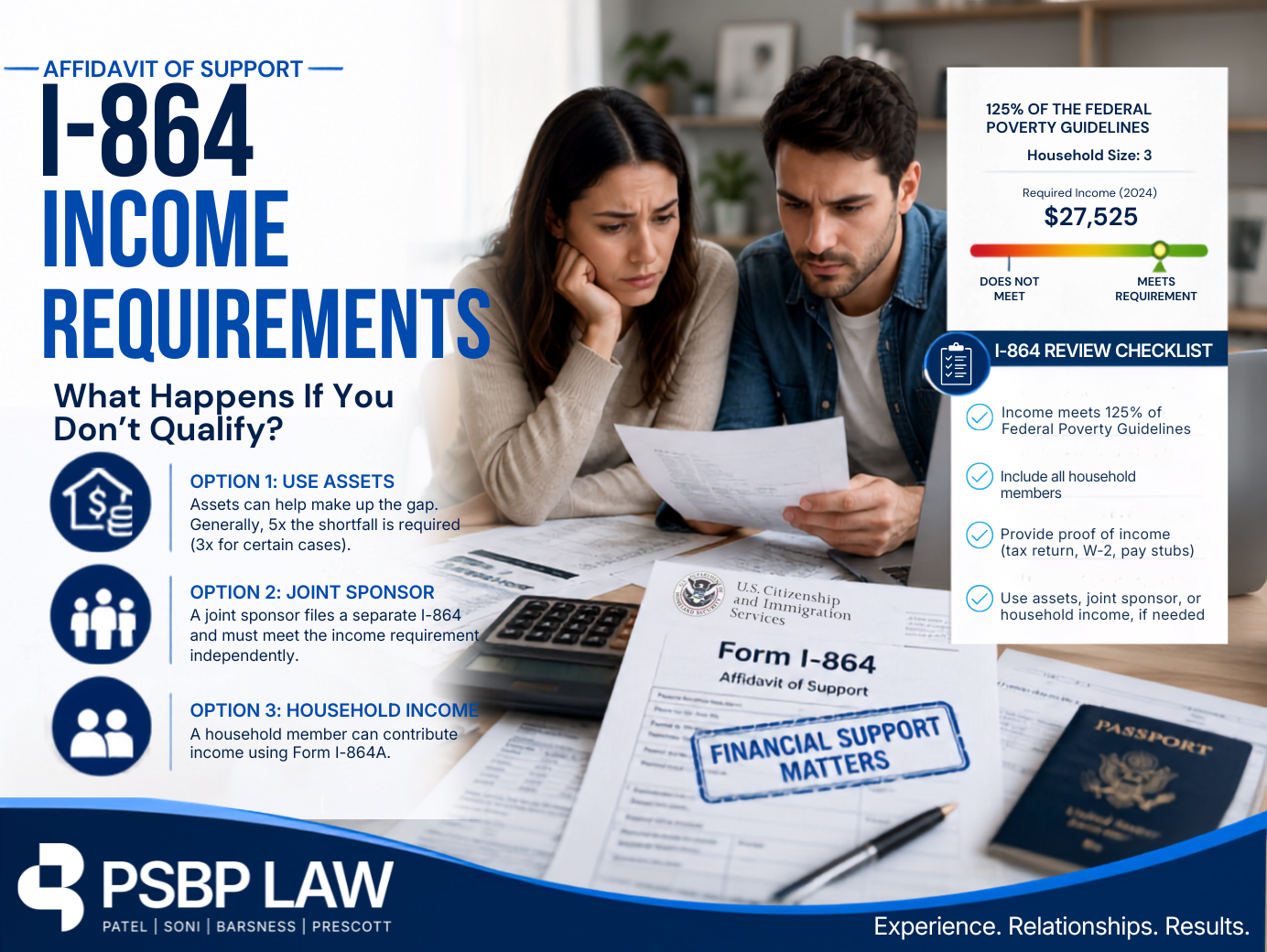
What Happens When the Income Requirement Is Not Met?
When a petitioner’s income falls below 125% of the FPG for their household size, they have several options.
Option 1: Count Assets
If income alone is insufficient, the petitioner may supplement their showing with assets. Under the I-864 rules, assets can make up the gap between the petitioner’s actual income and the required threshold, but the asset-to-income conversion is not dollar for dollar.
For most family-based cases, the value of assets must equal five times the difference between the petitioner’s income and the required amount. For example, if the petitioner is $5,000 short of the income threshold, they would need to demonstrate at least $25,000 in qualifying net assets.
For immediate relatives of U.S. citizens and certain other categories, the multiplier drops to three times the shortfall.
Qualifying assets generally include:
- Savings and checking account balances;
- Stocks, bonds, and certificates of deposit;
- Real property equity (net of any mortgage);
- Other assets that can be readily converted to cash within one year.
Option 2: Use a Joint Sponsor
If the petitioner cannot meet the income requirement through income or assets alone, they may recruit a joint sponsor, an additional person who files a completely separate I-864 on behalf of the intending immigrant.
A joint sponsor must:
- Be a U.S. citizen or lawful permanent resident;
- Be at least 18 years of age;
- Be domiciled in the United States; and
- Independently meet the 125% FPG threshold for their own household size, which includes the intending immigrant.
The joint sponsor does not need to be related to the petitioner or the intending immigrant. They can be a friend, a more financially stable family member, or any other qualifying individual willing to accept the legal obligations involved. The I-864 is a legally enforceable contract, not a formality.
Option 3: Use a Household Member’s Income
If someone lives in the petitioner’s household and their income contributes to the household’s finances, that person may file a Form I-864A, Contract Between Sponsor and Household Member, allowing their income to be combined with the petitioner’s for purposes of meeting the threshold.
A household member for I-864A purposes includes the petitioner’s spouse, adult children, parents, or siblings who live at the same address. The intending immigrant can also be counted as a household member if they currently live with the petitioner and will continue to do so after receiving their green card.
Unlike a joint sponsor, a household member does not file a separate I-864 — their income is pooled with the petitioner’s under a single affidavit. However, the household member must sign the I-864A and accepts legal obligations alongside the petitioner.
The Legal Weight of the I-864: What Petitioners Often Underestimate
The I-864 is a legally binding contract between the sponsor and the U.S. government. By signing it, the petitioner agrees to financially support the intending immigrant at or above 125% of the FPG for the duration of the obligation period.
The obligation does not end when the immigrant gets a green card. It continues until the immigrant:
- Becomes a U.S. citizen;
- Earns 40 qualifying quarters of work credit under Social Security (roughly 10 years of work);
- Permanently departs the United States;
- Loses or abandons lawful permanent resident status; or
- Dies.
Divorce does not terminate the obligation. A petitioner who sponsors a spouse for a green card and later divorces remains legally obligated to support that former spouse at the required income level until one of the above conditions is met.
Joint sponsors and I-864A household members accept the same obligations and face the same legal exposure.
Common Mistakes Petitioners Make
- Submitting only a tax return without current income evidence. If the petitioner’s most recent tax return reflects income below the threshold but their current income is sufficient, they must document the increase with a detailed employer letter, recent pay stubs, and a clear explanation of the discrepancy.
- Miscalculating household size. Failing to count prior I-864 beneficiaries, dependents not living in the home, or accompanying derivatives can lead to an incorrect assessment of whether the threshold is met.
- Choosing a joint sponsor who does not independently qualify. A joint sponsor who is close to the threshold but does not account for the intending immigrant being added to their household size may not actually meet the requirement once the correct calculation is applied.
- Assuming self-employment income is straightforward. Self-employed petitioners often run into difficulty when their tax returns show business deductions that reduce their reported income below the threshold even though their actual earnings are higher. Documentation in these cases requires careful handling of Schedule C, Schedule K-1, and other supporting materials.
- Not preparing the I-864 in advance. For consular processing cases in particular, delays in obtaining or preparing the I-864 are one of the most common causes of postponed immigrant visa interviews. The form, tax transcripts, and supporting financial documents should be assembled well before they are needed.
Conclusion
Meeting the I-864 income requirement can be a challenging aspect of family-based immigration for many petitioners. The regulations provide legitimate pathways when a petitioner falls short: assets, joint sponsors, and household member income contributions can all bridge the gap when properly documented and presented.
What matters most is identifying the shortfall early, understanding which remedy fits your situation, and preparing the documentation carefully. The I-864 is not a form to rush through, it is a legal commitment with long-term consequences.
If you are concerned about whether you or your petitioner meets the I-864 income requirement, our office can review your financial situation and help you identify the best path forward. Contact Attorney Natalia Meade at nmeade@psbplaw.com to schedule a consultation.