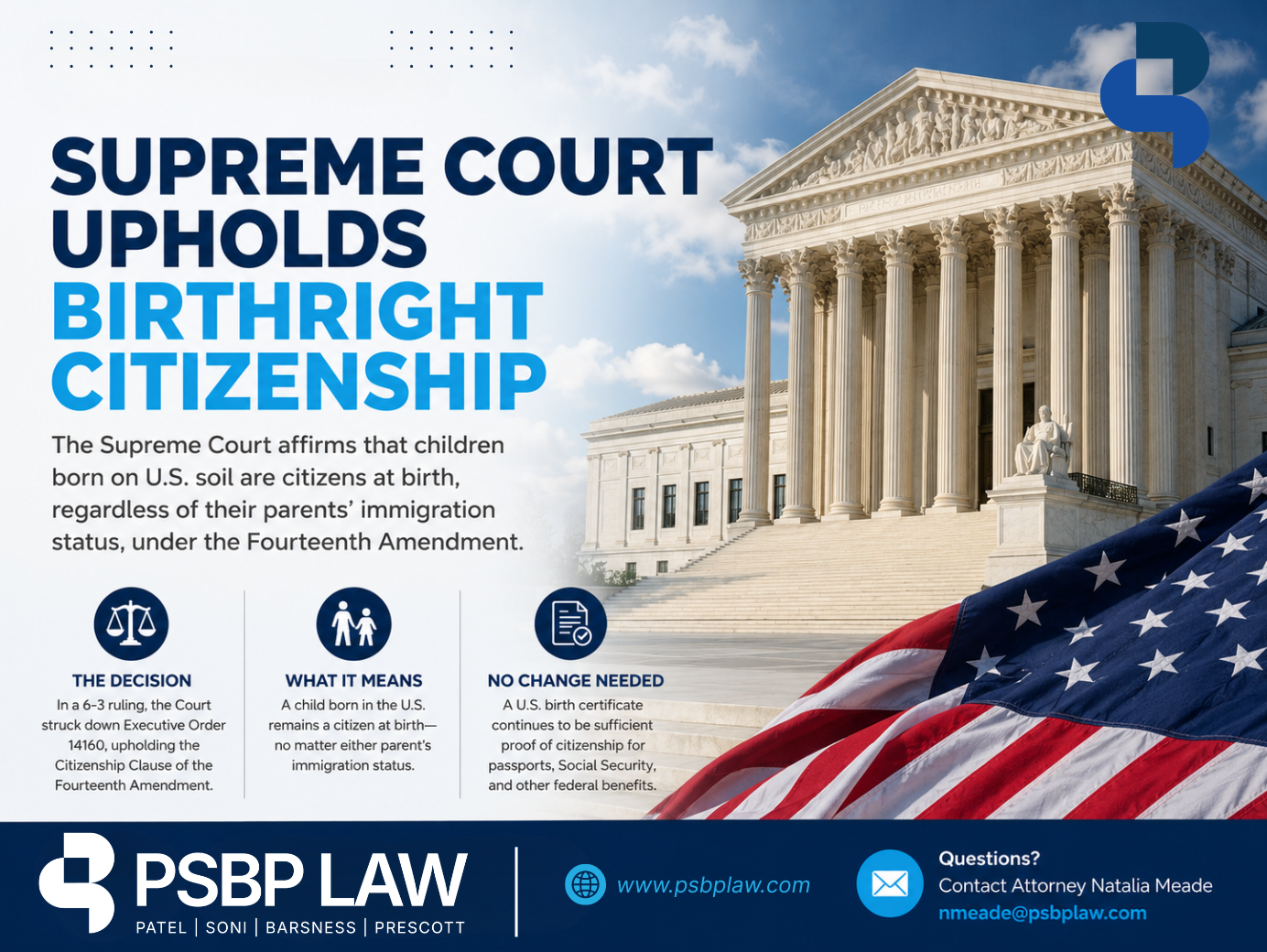
In a 6-3 decision issued today, the U.S. Supreme Court struck down President Trump’s executive order seeking to restrict birthright citizenship under the Fourteenth Amendment, affirming what has been the settled understanding of American law for over a century: children born on U.S. soil are citizens at birth, regardless of their parents’ immigration status.
What Happened
The case, Trump v. Barbara, challenged Executive Order 14160, “Protecting the Meaning and Value of American Citizenship,” which Trump signed on the first day of his second term. The order attempted to deny citizenship to two categories of U.S.-born children: those whose mothers were unlawfully present and whose fathers were not citizens or lawful permanent residents, and those whose mothers were lawfully but only temporarily present (such as on a student or work visa) without a citizen or LPR father.
Every lower court to consider the order blocked it, and it never took effect. The Supreme Court agreed to hear the case on an expedited basis, and oral arguments took place on April 1, 2026.
What the Supreme Court Decided
Most of the Justices held that the order violates the Citizenship Clause of the Fourteenth Amendment. The Court relied heavily on its landmark 1898 decision in United States v. Wong Kim Ark, which held that a child born in California to Chinese immigrant parents was a U.S. citizen because he was born on U.S. soil and “subject to the jurisdiction” of the United States.
The administration had argued that “subject to the jurisdiction thereof” should be read to require some form of domicile or lawful permanent presence by a parent. The majority rejected that reading, holding that physical presence in the United States, not immigration status or domicile, triggers jurisdiction for purposes of the Citizenship Clause.
Chief Justice Roberts wrote the main opinion, joined by four other justices. One more justice, Kavanaugh, agreed with the outcome but for a different reason. Three justices (Thomas, Alito, and Gorsuch) disagreed and would have allowed the executive order to stand.
What This Means in Practice
For now, nothing has changed. The executive order never took effect, and today’s decision confirms that it never will. Specifically:
A child born in the United States remains a U.S. citizen at birth regardless of either parent’s immigration status, including children born to parents who are undocumented, on temporary visas, or in any other nonimmigrant category. A U.S. birth certificate continues to be sufficient proof of citizenship for passports, Social Security numbers, and other federal benefits. There is no new documentation or verification process for parents to navigate.
Why It Matters for Our Clients
This decision provides important certainty for the many families we work with who have U.S.-citizen children born while a parent’s status was pending, temporary, or otherwise in flux. It also reinforces a planning point we regularly walk clients through: a U.S.-citizen child does not, on its own, confer immigration status on a parent, and questions about adjustment of status, consular processing, or removal defense still require their own analysis. If you have questions about how a U.S.-citizen child factors into your or a family member’s immigration case, our team is here to help you understand your options.
This article is for general informational purposes and does not constitute legal advice. Immigration law is fact-specific. Questions? Contact Attorney Natalia Meade at nmeade@psbplaw.com.