A Department of Homeland Security final rule that would eliminate “Duration of Status” (D/S) for F-1 students (also J-1 visa holders) has now cleared the Office of Management and Budget (OMB). The OMB cleared the rule (RIN: 1653-AA95) on June 17, 2026, the last procedural step before publication in the Federal Register. The rule is expected to take effect 60 days after publication and could apply to new students arriving as early as September 2026.
Unlike some of the recent memos which the administration has used to try and alter our immigration laws, this rule will result in a new regulation that has legal authority. This means once it is in effect it will become law, making a legal challenge much more difficult. However, legal challenges are still expected, given the potential devastating impact and additional cost to F-1 students.
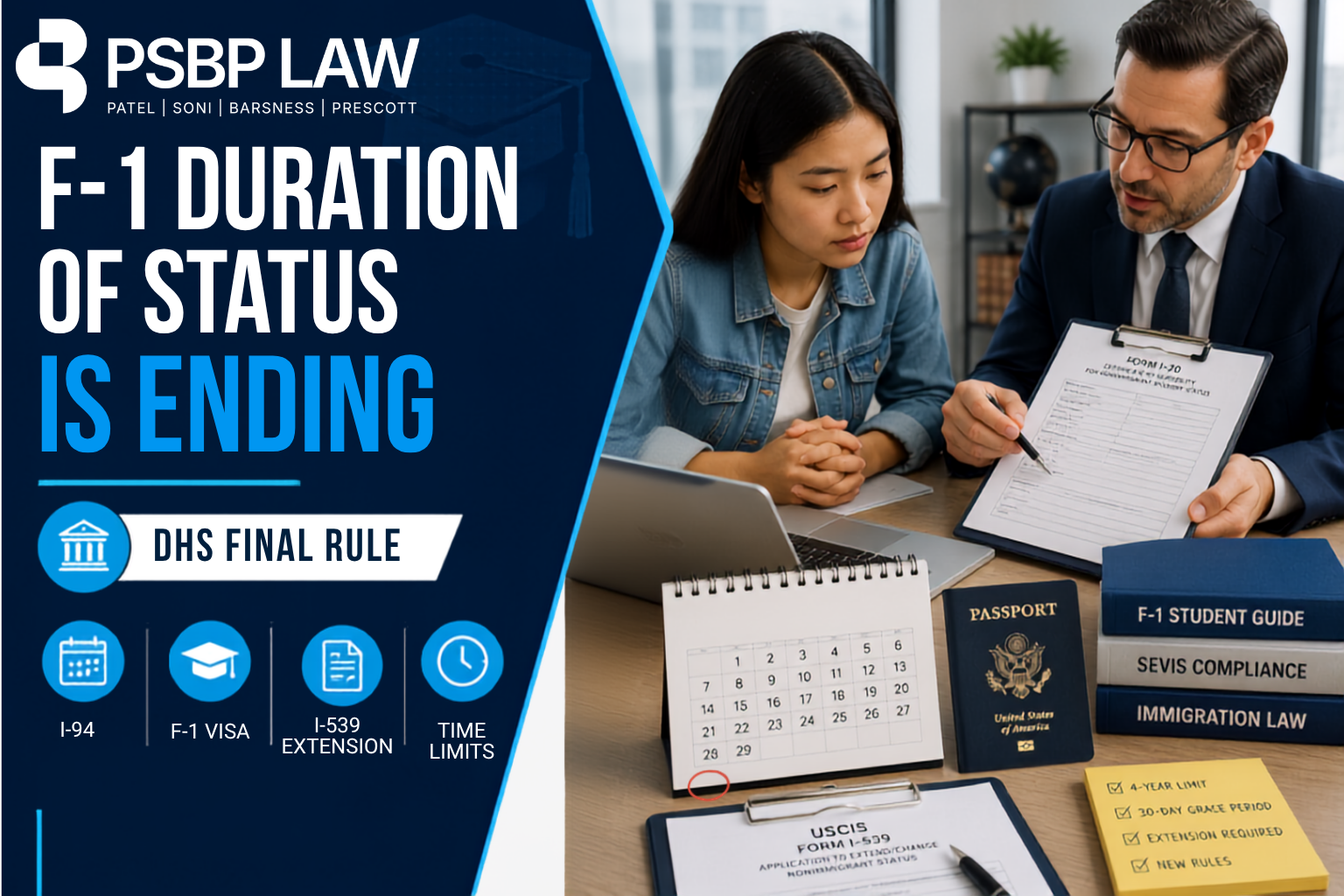
Instead of being admitted to D/S students will now receive a fixed four-year cap replacing the decades-old open-ended admission framework.
What Is Changing?
For more than 30 years, F-1 students have been admitted for “Duration of Status,” their Form I-94 carrying no fixed end date and allowing them to remain in the United States as long as they maintained valid program enrollment and academic progress. Designated School Officials (DSOs) have had broad authority to extend stays, approve school transfers, and update SEVIS records without any USCIS filing.
Similarly, individuals could apply for work authorization (OPT/ STEM OPT) without having to extend their I-94. For those not selected in the H-1B lottery that had utilized their practical training options, they could switch to a Day 1 CPT college, without having to ask for permission from USCIS. Well, this is all about to change.
Key changes include:
Fixed admission period.
F-1 students will receive a specific I-94 expiration date tied to their program end date as listed on their Form I-20 capped at four years. Students whose programs exceed four years including most PhD candidates, who typically complete degrees in five to eight years must file Form I-539 with USCIS, pay the $470 base filing fee, attend a biometrics appointment, and await adjudication before their authorized stay expires.
Shortened grace period.
The standard F-1 post-completion grace period is cut from 60 days to 30 days. Unlawful presence begins the day after a denial or the day after the grace period expires. Typically, students did not accrue unlawful presence due to being admitted for duration of status. This rule will potentially see more students overstating their status, resulting in the three- or ten-year bars.
Restrictions on program and school changes.
F-1 students generally may not change educational levels, degree programs, or fields of study within the first year after the program start date on their initial I-20.
Students completing a bachelor’s degree who wish to begin a master’s program would not see their four-year admission clock reset. If the combined timeline exceeds four years, an I-539 filing is required.
No lateral or backward educational moves.
Under the current system, F-1 students may pursue another degree at the same or lower level. The rule would require progression to a *higher* educational level, ending that option. This means the option of taking a second master’s degree to obtain Day 1 CPT would effectively come to an end.
Conclusion
International students have been specifically targeted by this administration. It was only last year that DHS began terminating students’ SEVIS records for issues as minor as a stop sign violation. However, this rule has the potential to significantly reshape the F-1 student landscape.
Limiting the number of international students in the United States will likely have a knock-on effect on H-1B and other employment-based visa categories, as many foreign nationals first enter the U.S. as an F-1 student before transitioning to another visa status.
The elimination of Duration of Status also means that students will now need to closely monitor the validity of their Form I-94 and ensure that any required extension is filed well before it expires. Failure to do so could result in the accrual of unlawful presence and potentially trigger the three- or ten-year bars to reentry.
Finally, requiring students to progress only to a higher educational level will effectively eliminate the common practice of enrolling in a second master’s program to maintain F-1 status through Day 1 CPT.
While legal challenges are expected, this is a formal regulation, not simply an agency memo and, when it takes effect, it will fundamentally change how F-1 students maintain lawful status in the United States. Students, universities, and employers should begin preparing now for what could be the most significant overhaul of the F-1 program in decades.
If you have any questions regarding the above, please contact PSBP Law Partner Chris Prescott at cprescott@psbplaw.com.