A common question asked by EB-5 investors is: “If I get married during the EB-5 process, can my spouse receive a green card with me?”
The answer depends largely on when the marriage occurs. In many cases, the timing of the marriage can determine whether a spouse receives a green card as a derivative beneficiary through the EB-5 petition or must instead pursue a separate family-based immigration process.
Understanding Derivative Beneficiary Status
Under the EB-5 program, an investor’s spouse and unmarried children under 21 may qualify as derivative beneficiaries. This allows eligible family members to obtain permanent residence based on the investor’s approved EB-5 petition without making a separate qualifying investment.
For spouses, eligibility generally depends on whether a valid marital relationship exists at the relevant stages of the immigration process.
Scenario 1: Marriage Before Filing the I-526E Petition
If an investor is legally married before filing Form I-526E, the spouse can be included as a derivative beneficiary from the start of the filing. Assuming the petition is approved and all eligibility requirements are met, the investor and spouse may proceed together through adjustment of status or consular processing.
Scenario 2: Marriage After Filing I-526E but Before Receiving a Green Card
Many investors become engaged or married while their EB-5 petition is pending. Fortunately, marriage during this stage does not necessarily prevent a spouse from obtaining immigration benefits through the EB-5 case.
If the investor marries before becoming a conditional permanent resident, the spouse can generally be added as a derivative beneficiary during the adjustment of status or immigrant visa stage. The marriage must be legally valid, and appropriate documentation must be provided to establish the relationship including but not limited to the marriage certificate.
This timing often allows both spouses to obtain conditional permanent residence through the same EB-5 investment.
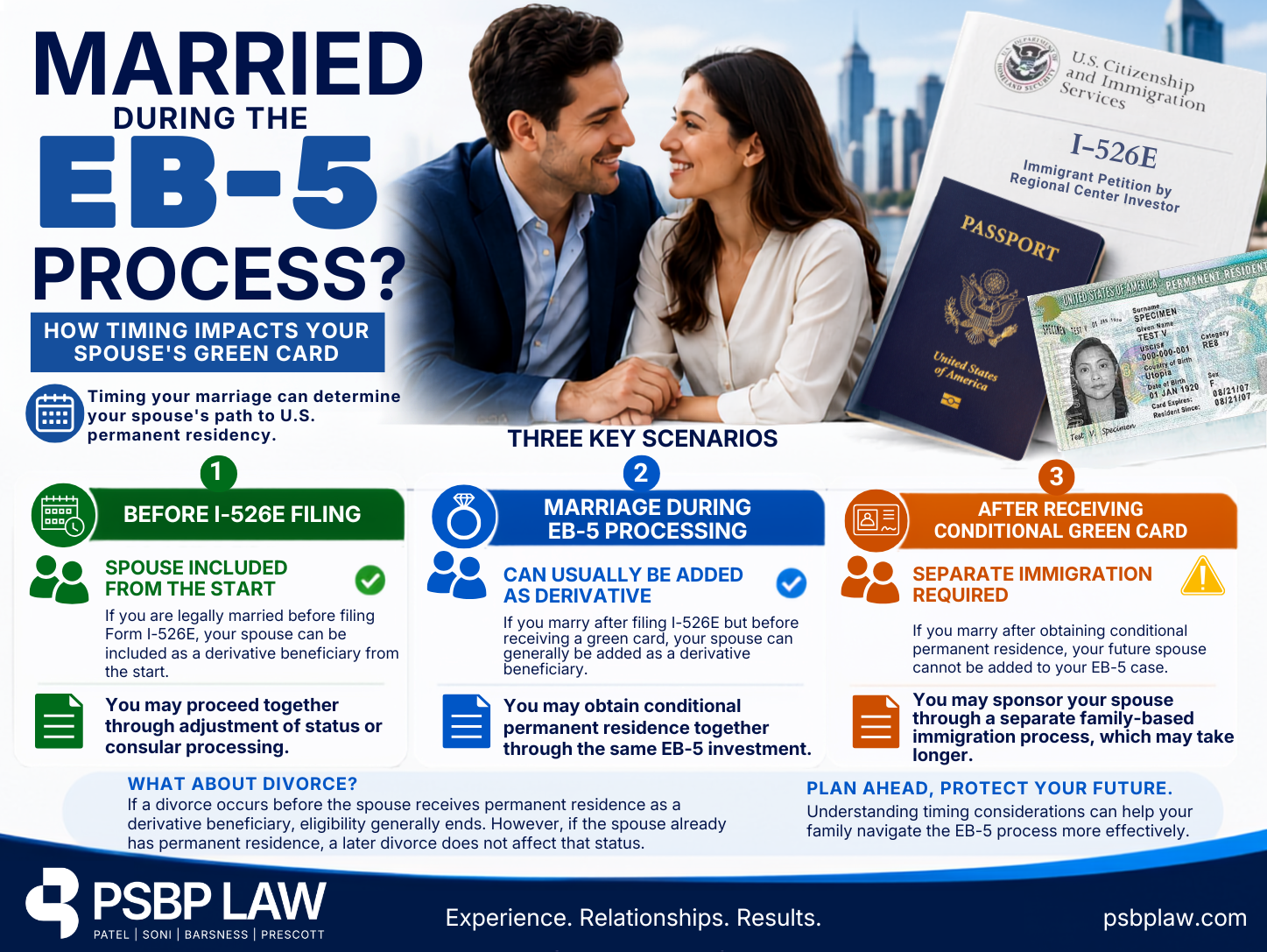
Scenario 3: Marriage After Receiving Conditional Permanent Residence
Once an investor has obtained conditional permanent resident status through the EB-5 program, a spouse whom the investor marries thereafter generally cannot be included as a derivative beneficiary in the investor’s EB-5 case.
As a result, marrying after obtaining the conditional green card can lead to additional filings and potentially longer processing times for the spouse.
What About Divorce?
If a divorce occurs before the spouse receives permanent residence as a derivative beneficiary, eligibility based on the marriage generally ends because the qualifying relationship no longer exists. However, if the spouse has already obtained permanent resident status, a subsequent divorce does not automatically affect that status.
Practical Considerations for EB-5 Investors
The timing of your marriage can significantly impact whether your spouse may obtain a green card as a derivative beneficiary through your EB-5 case or will need to pursue a separate immigration process. Understanding these timing considerations can help families plan ahead and navigate the EB-5 process more effectively.
Navigating the EB-5 process can be complex, especially when family circumstances change. If you have questions about spouse eligibility, derivative beneficiaries, or EB-5 immigration planning, contact Attorney Jacqueline Treviño at jtrevino@psbplaw.com.