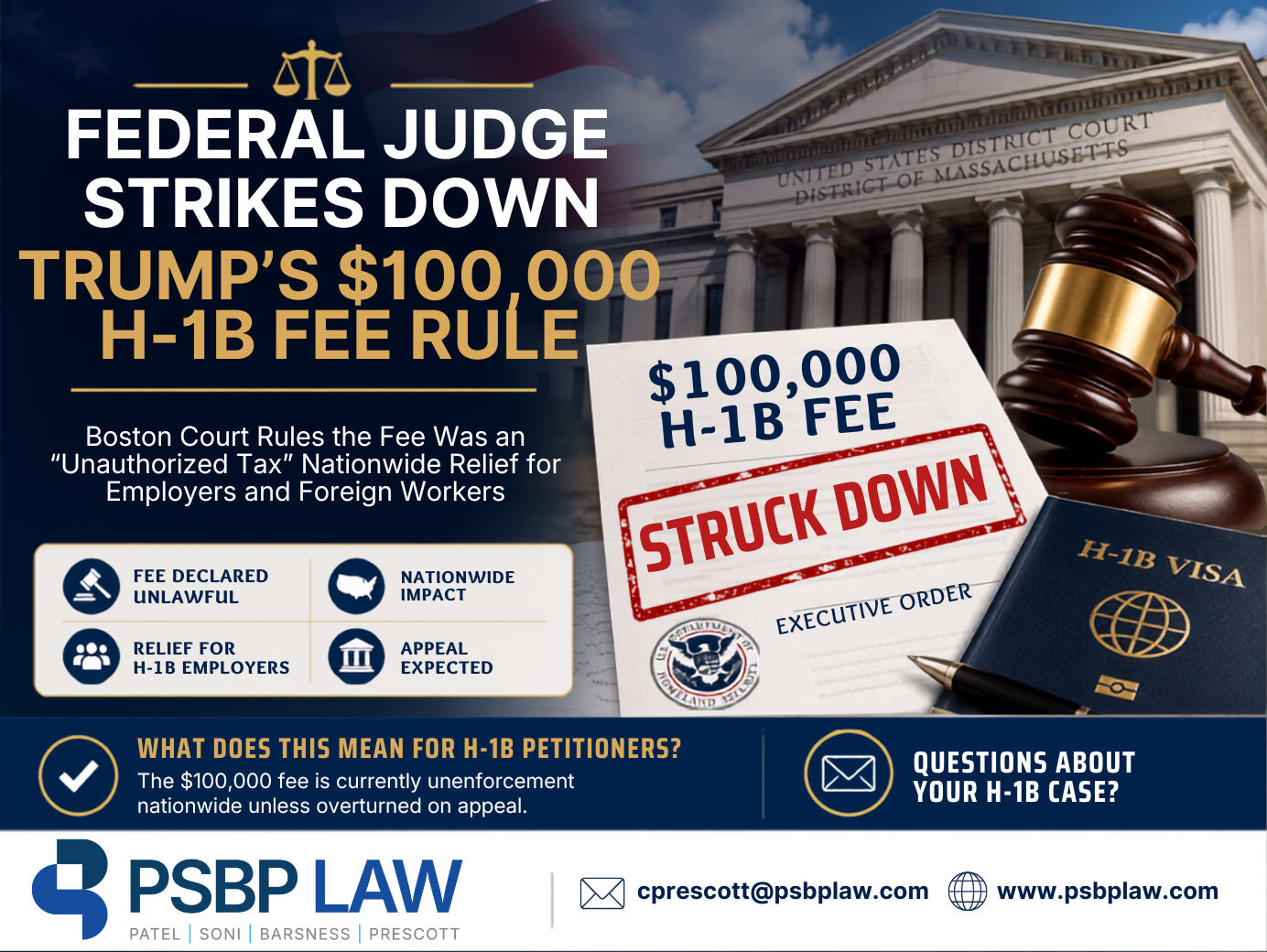
In a long-awaited decision, a federal judge has declared the Trump administration’s attempt to impose a $100k fee on certain H-1B workers to be unlawful.
Last September, the immigration community was shell-shocked when the Trump administration announced a $100k fee applicable to certain H-1B workers. Practitioners, employers, and employees initially scrambled to understand what the fee meant and who it would apply to. Shortly after the announcement, USCIS clarified that the fee applied to new petitions filed on or after September 21, 2025, for the following individuals:
- Those outside of the U.S. without a valid H-1B visa.
- Those who requested consular processing.
- Those who were determined not to be in valid status and had their case approved for consular processing.
This fee had a dramatic impact on the number of applicants in the H-1B lottery, especially for those outside of the U.S. Ironically, due to the reduced number of applicants, those inside the U.S. actually benefited, seeing significantly higher selection rates compared to previous years.
The First Lawsuit: A Blow to the Immigration Community
The first major legal challenge, filed by the U.S. Chamber of Commerce, was unsuccessful and delivered a significant blow to the immigration community. The judge in that case found that the $100k fee fell within the President’s statutory authority to restrict the entry of non-citizens into the U.S.
The States Step In
Not long after, a coalition of state attorneys general mounted their own challenge. California Attorney General Rob Bonta led a coalition of 20 attorneys general in announcing a lawsuit challenging the Trump administration over its policy, arguing that H-1B visas allow U.S. employers to hire highly skilled foreign national workers in roles requiring specialized skills including physicians, researchers, nurses, and other vital workers to alleviate nationwide labor shortages. The states argued that the policy impedes their ability to hire primary and secondary school educators and to staff public colleges and universities.
The Boston Ruling
After a much-anticipated wait, U.S. District Judge Leo Sorokin in Boston issued a ruling in the lawsuit filed by the 20 Democratic state attorneys general, striking down the fee that Trump announced in September. In a 42-page decision, he concluded that the payment functioned as a tax regardless of the label the government gave it, and that no statute authorized the executive branch to impose it.
Judge Sorokin agreed with the plaintiffs that the fee imposed by Trump’s executive order amounted to an “unauthorized tax,” as opposed to a “regulatory payment,” as the Trump administration contended.
What This Means — And What Comes Next
As a result of this decision, the $100,000 H-1B fee is no longer enforceable and cannot currently be imposed by the administration. The ruling applies nationwide.
That said, this is unlikely to be the final word, The Trump administration has already indicated that it intends to appeal the decision, meaning further litigation is expected.
For H-1B petitioners and employers, however, the immediate impact is substantial. Unless and until the ruling is overturned or stayed on appeal, the $100,000 fee cannot be collected, providing significant short-term relief for employers and foreign nationals alike.
We will continue to monitor the situation and provide updates as appropriate. If you have questions regarding the recent ruling please e-mail PSBP Law Partner Chris Prescott at cprescott@psbplaw.com.