Over the past year, I have seen a growing number of highly educated, accomplished, and genuinely talented professionals assume they qualify for EB-1A classification simply because they have a strong résumé.
That is not enough.
In 2026, USCIS is scrutinizing EB-1A petitions far more aggressively than it did several years ago. Many denials are not because the individual lacks talent or achievement. They are denied because the petition fails to establish something much more difficult:
That the individual has risen to the very top of their field and sustained that acclaim over time.
The problem is that many applicants approach EB-1A like a checklist exercise:
- Publications
- Citations
- Judging
- Memberships
- Awards
But EB-1A was never intended to reward people for simply accumulating credentials. The real question is whether the evidence tells a convincing story that the field itself recognizes the person as extraordinary. Before spending thousands of dollars, months gathering evidence, or filing a weak petition, every prospective EB-1A applicant should answer three questions honestly.
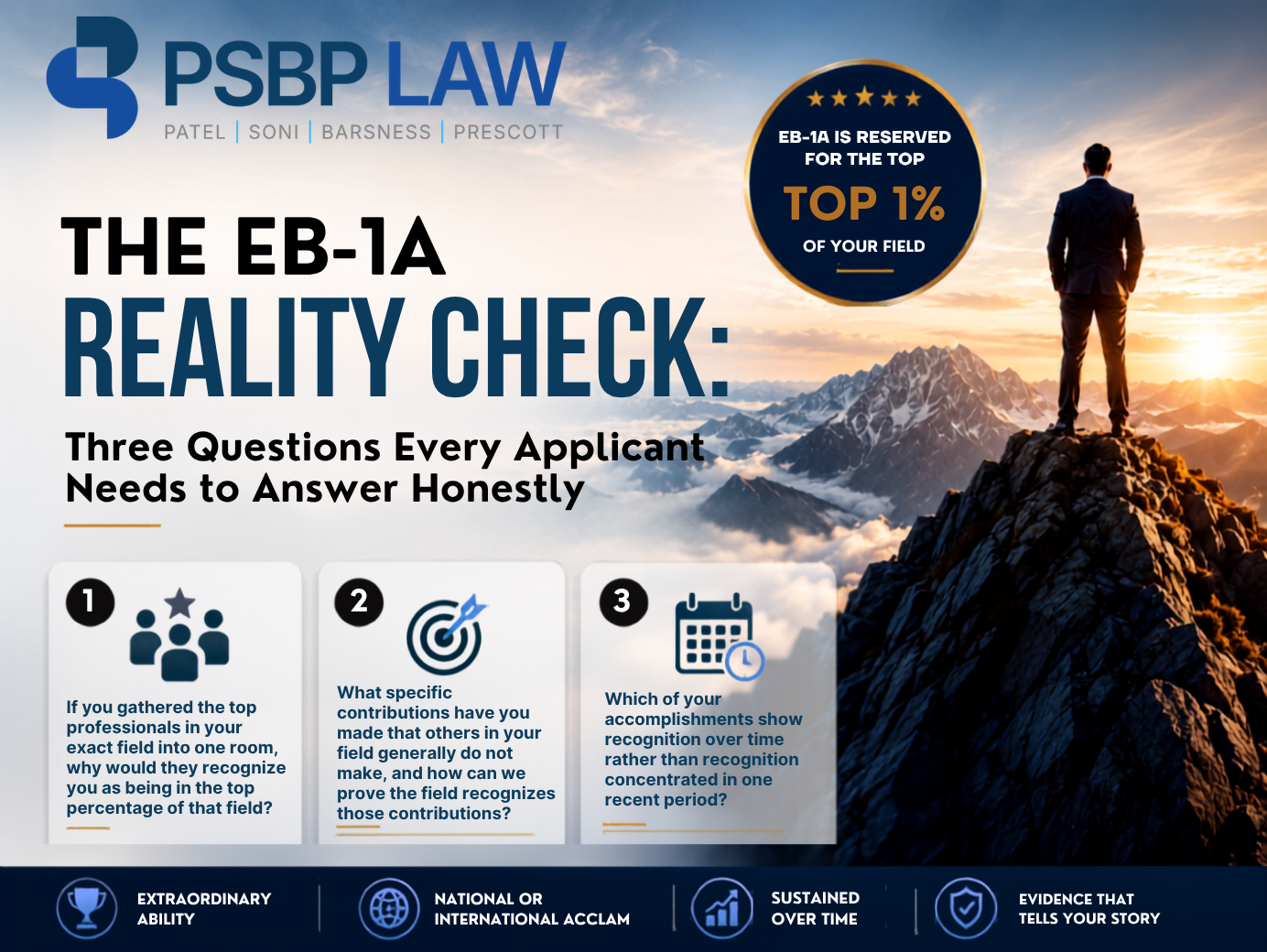
1. If you gathered the top professionals in your exact field into one room, why would they recognize you as being in the top percentage of that field?
This is the single most important question in EB-1A analysis. The question is whether the top professionals in your field would recognize you as one of the top professionals in that field.
Many people dramatically overestimate the strength of their profile because they compare themselves internally within their company rather than externally across the field.
For example:
- A Senior Software Engineer at a major tech company may still be relatively unknown in the broader field.
- A physician with years of experience may still lack field-wide recognition.
- A manager leading a large team may still not have made original contributions recognized outside the company.
USCIS is conducting a comparative analysis whether the petition explicitly frames it that way or not. The officer is essentially asking:
“What separates this person from the thousands of other professionals with similar education, experience, and job titles?”
If the answer requires multiple pages of explanation, the case likely lacks a clear EB-1A narrative.
The strongest cases usually have a concise answer:
- “He developed fraud detection architecture adopted by multiple financial institutions.”
- “Her machine learning framework became part of large-scale aviation safety systems.”
- “His research is consistently cited by leading researchers in this niche field.”
That is recognition and is exactly what USCIS is looking for.
2. What specific contributions have you made that others in your field generally do not make, and how can we prove the field recognizes those contributions?
This is where many cases collapse. Applicants often describe responsibilities instead of contributions. There is a major difference between managing projects, participating in initiatives, or being part of successful teams versus making original contributions of major significance.
USCIS increasingly wants evidence showing innovation, measurable impact, adoption, influence, implementation, or field-level recognition. Simply arguing that someone is critical is not sufficient. Every recommendation letter in America says someone is “critical.” That language carries very little weight without objective corroboration. The better question is: “What happened because of your work that would not have happened otherwise?”
Examples may include:
- technology adopted across organizations,
- patents implemented commercially,
- systems reducing operational costs at scale,
- frameworks adopted as standard practice,
- publications influencing ongoing research,
- methodologies replicated by others,
- products generating measurable revenue,
- or contributions solving problems others in the field could not solve.
Equally important is whether you can prove that the field recognizes your contributions through things such as citations, independent recommendation letters, media coverage, implementation evidence, industry adoption, contracts, metrics, conference invitations, judging invitations etc.
A common mistake in EB-1A cases is confusing internal value with field-level recognition. Being valuable to your employer is not the same as being recognized as extraordinary within the field.
3. Which of your accomplishments show recognition over time rather than recognition concentrated in one recent period?
This issue has become increasingly important in 2025 and 2026. USCIS is heavily scrutinizing the “sustained” component of “sustained national or international acclaim.”
In other words, was the recognition maintained over time, or was it assembled rapidly for immigration purposes. Officers are now looking carefully at the following:
- when memberships were obtained,
- when judging began,
- when awards were received,
- and whether the evidence reflects genuine long-term distinction.
For example:
- judging activity that began six months before filing,
- memberships obtained shortly before filing,
- or awards concentrated in a single year,
may technically satisfy a criterion but still create weakness during Final Merits Determination.
This is one of the biggest misconceptions in EB-1A practice:
Meeting three criteria does not guarantee approval. In many recent denials, USCIS concedes multiple criteria and still denies the case at Final Merits because the evidence does not collectively establish sustained acclaim. Strong cases typically show progression over multiple years.
Too many candidates want attorneys to help “build” an EB-1A profile.
At PSBP Law, we do not manufacture eligibility. EB-1A classification is earned through sustained achievement, recognition, and impact in your field not created through artificial last-minute efforts designed to check boxes. Our role is to identify genuine extraordinary ability, present it strategically, and prove it with credible evidence. Not to create a profile that never truly existed.
Conclusion
Be realistic about your chances. EB-1A is an extraordinary standard reserved for individuals at the very top of their field who can demonstrate sustained national or international acclaim.
One of the first EB-1A cases I ever worked on initially appeared to be a strong case. The candidate could satisfy several criteria, but USCIS ultimately took the position that he was on his way to the top and simply had not reached it yet. The case was denied.
Future potential is not enough. You may be climbing the mountain and building an impressive career, but until you can clearly demonstrate that you have reached the top tier of your field, you may not yet be ready to apply for EB-1A. If you have questions regarding your eligibility please reach out to PSBP Law Partner, Chris Precsott, by e-mail at cprescott@psbplaw.com