One of the most common questions from EB-5 investors is simple: when do I actually get my green card? The answer depends on a recurring checkpoint that shapes the entire timeline: the visa bulletin, combined with a variety of different USCIS applications, each playing its own role along the way.
Understanding what each of these applications does and how they affect one another, helps investors set realistic expectations and plan their filings strategically.
Step 1: Check the Visa Bulletin (First Check) When Filing the I-526/E
On the visa bulletin, ‘C’ means current. That means visa numbers are authorized for issuance to all qualified applicants in that category. When the EB-5 set-aside categories are current (rural, high unemployment, and infrastructure), investors can concurrently file the I-485, I-131, and I-765 alongside the I-526/E.
- Form I-485 — Application to Register Permanent Residence (adjustment of status)
- Form I-131 — Application for Travel Document (advance parole)
- Form I-765 — Application for Employment Authorization Document (EAD)
Each of these applications has its own separate processing time. The benefit, however, is that investors don’t need to wait to submit them. They can be filed together as long as the visa bulletin is current at the time of filing. This means an investor can typically obtain work authorization and travel permission while their I-526/E, and later their I-485, are still pending approval, rather than waiting years for those benefits.
If the visa bulletin is not current at the time of filing, the I-526/E is filed on its own, and the I-485 cannot be filed until a visa becomes available later.
Step 2: I-526/E Approval — The Foundational Petition
Investors who invest directly file Form I-526 (Immigrant Petition by Standalone Investor), while investors who invest through a regional center file Form I-526E (Immigrant Petition by Regional Center Investor).
These are the immigrant investor petitions, and their approval is the foundation of the green card benefit.
It’s the EB-5 equivalent of an I-130 (family-based petition) or an I-140 (employment-based petition) in other green card categories. It establishes that the investor and the investment meet the legal requirements of the category before any green card can be granted.
Without I-526/E approval, there is no path to permanent residence through EB-5. It confirms the investment was made correctly, the funds were lawfully sourced, and the required job-creation criteria are on track to be met.
Step 3: Check the Visa Bulletin Again (Second Check)
At the point of I-526/E approval, the visa bulletin becomes relevant again. This time to determine whether the I-485 can actually be adjudicated and approved by USCIS.
If the investor already filed concurrently in Step 1 and the visa remains current, green card processing can begin after the I-526/E is approved.
If the investor filed the I-526/E alone because a visa wasn’t available at the time, this second visa bulletin check determines when the I-485 (or, for those outside the U.S., consular immigrant visa processing) can even proceed.
The visa bulletin isn’t a one-time hurdle. It’s checked at two distinct points: once before/at I-526/E filing (to see if concurrent filing is possible), and again at I-526/E approval (to see if the green card step can move forward).
Step 4: I-485 Approval — Conditional Green Card
Once the I-485 is approved, the investor receives a conditional green card, valid for two years. It’s issued as “conditional” because the investor must still prove that the investment met all EB-5 requirements. This most notably involves confirming that the investment created the required jobs.
Step 5: I-829 — Removing Conditions for the Permanent Green Card
Investors can file Form I-829 (Petition by Investor to Remove Conditions) 90 days before the 2-year anniversary of receiving conditional status.
The I-829 requires the investor to demonstrate that the investment requirements were actually satisfied (i.e., that the required number of jobs was created). Once USCIS approves the I-829, the conditions are removed, and the investor receives a permanent green card, valid for 10 years.
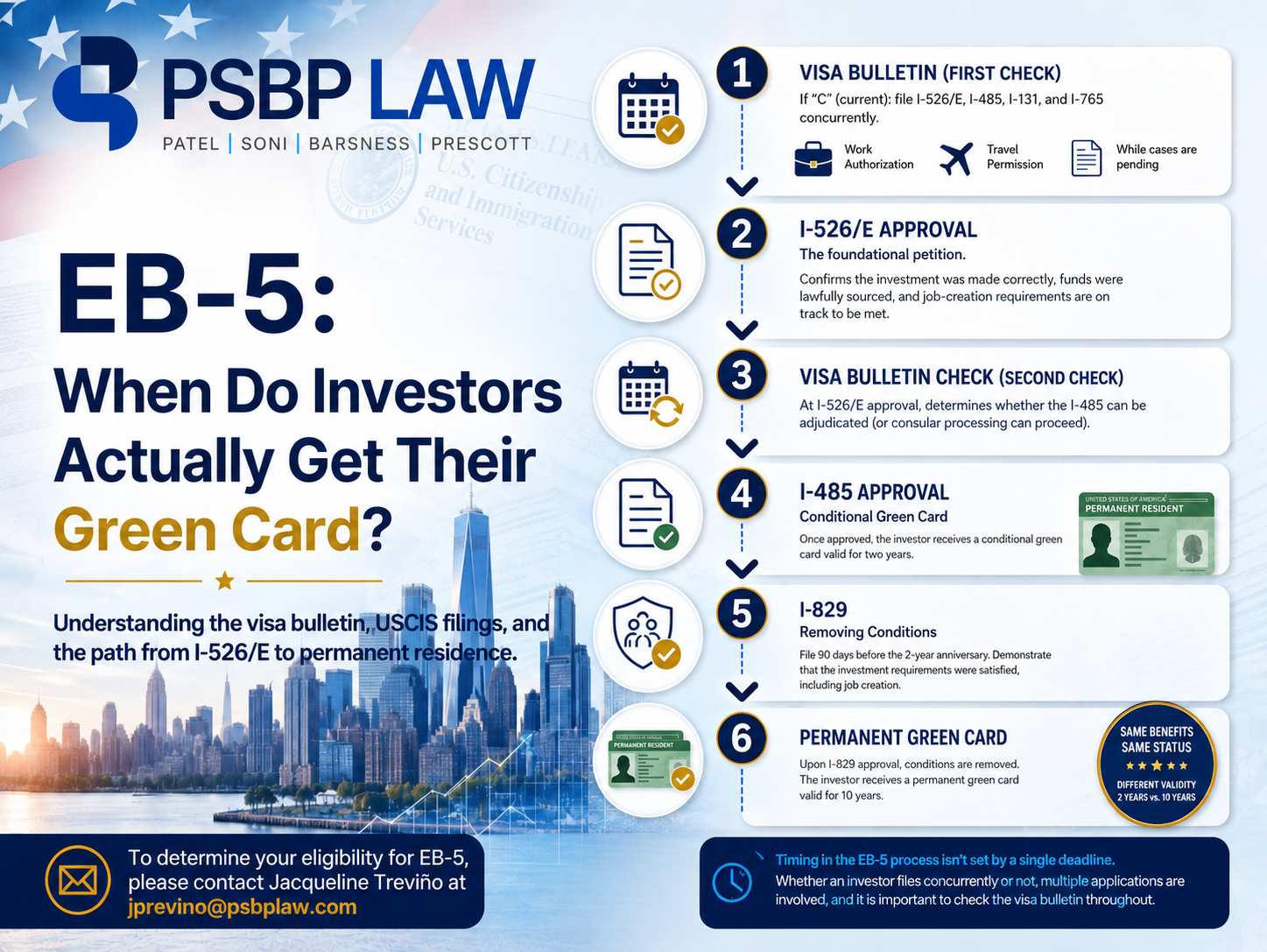
The conditional green card and the permanent green card carry the same benefits and status as a lawful permanent resident. The only real difference between the two is validity: two years for the conditional green card versus ten years for the permanent green card.
Timing in the EB-5 process isn’t set by a single deadline. Whether an investor files concurrently or not, multiple applications are involved, and it is important to check the visa bulletin throughout.
To determine your eligibility for EB-5, please contact Jacqueline Treviño at jtrevino@psbplaw.com.