For employers sponsoring their employees for a green card, demonstrating ability to pay the offered wage has always been one of the requirements. However, although we typically address this with our clients at the outset, during the PERM stage, actually demonstrating the ability to pay does not usually come into play until the I-140 stage. At this point employers typically submit their annual tax returns along with evidence of wages paid to the beneficiary to show that they have the financial ability to pay the offered wage (often this is more than the beneficiary’s H-1B wage) when the beneficiary receives their green card.
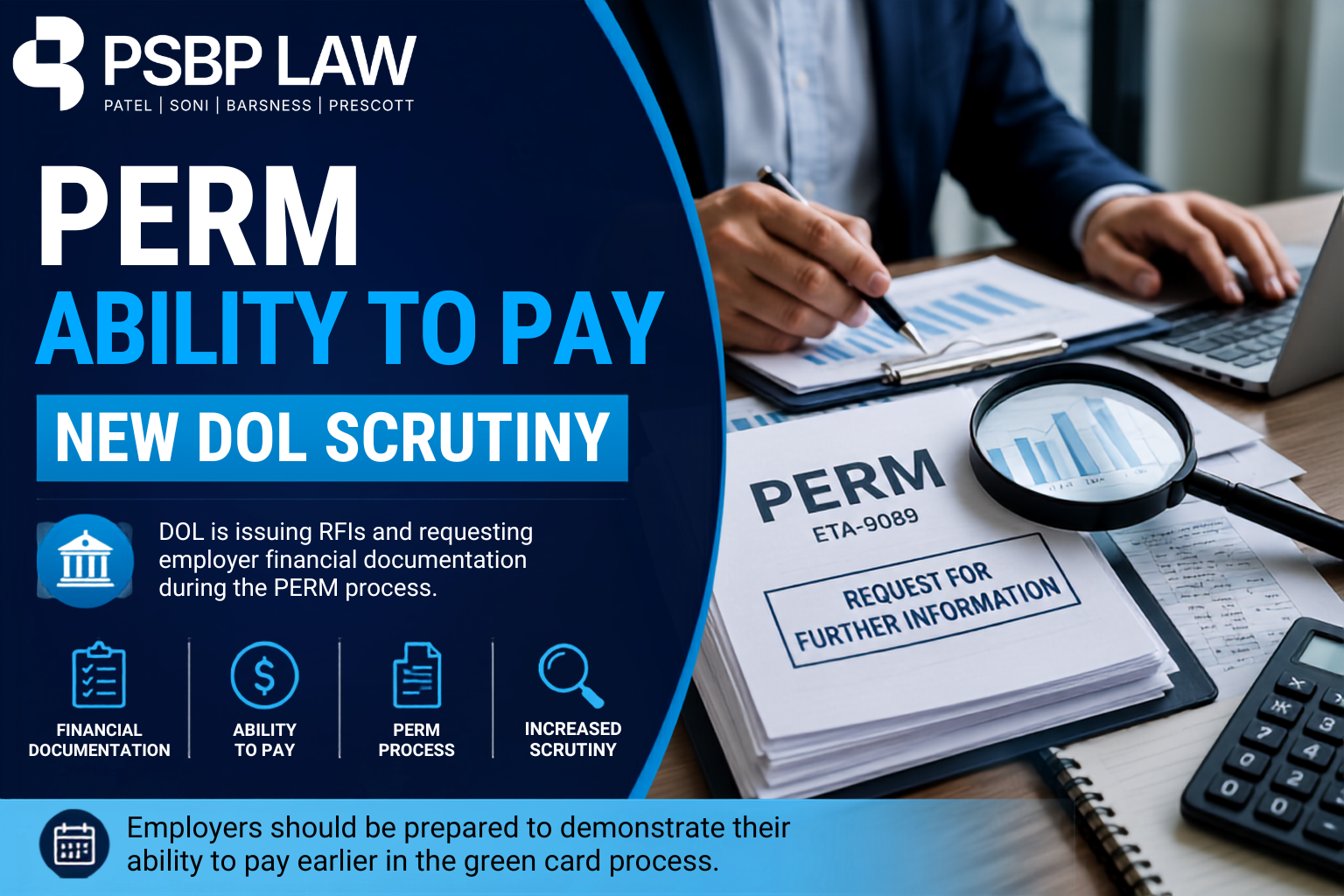
However, a new troubling trend indicates that the Department of Labor (DOL) is now questioning whether Employers have the ability to pay at the PERM stage by issuing a Request for Further Information (RFI).
Having filed PERMs for approximately 15 years I received my first RFI questioning whether my client has the ability to pay the wage. The wording of the RFI is below:
“The employer filed a Form ETA 9089 for the position of Software Developer and attested in Section E-3, it will pay an offered wage of $100,000.00 per year, for the job opportunity. Given the employer’s status, the Certifying Officer requests updated information confirming the employer’s ability to pay the offered wage, a criterion essential to demonstrate the employer actually has a bona fide job opportunity available.
The documentation must include but is not limited to the following:
1. State payroll tax documentation for 2024 to current.
2. Quarterly bank statements for 2024 to current and/or the latest profit-and-loss statement from an accountant.
3. Federal income tax statement for 2024 to current. (If current tax statement is unavailable explain why and provide supporting documentation to substantiate claim, i.e., IRS document to show an extension of time to file taxes was granted.)
4. A listing of the current employees, their job titles, and annual salaries employed in the business.
5. Current Year to Date (YTD) work contracts or letter of intent for work to be performed in the coming year, which must identify the revenue to be generated by the contract(s).
6. If the employer proposes to use personal funds to pay the wage or salary offered the foreign worker, then employer’s personal income and financial statements for the last three years must be provided.
7. Copies of all W-2 forms issued to employees, including the foreign worker (if applicable), for work performed during 2024 to current who work in the home.
8. Copies of all 1099 forms issued to contractors in any Software Developer positions for work performed in 2024 to current.”
While the DOL has not traditionally performed the ability to pay function in the past, Employers are required to attest that they have enough funds to pay the beneficiary’s wage when filing the PERM and therefore any argument that DOL does not have the authority to question this, will most likely fail.
What does this mean going forward?
Employers should therefore be prepared to demonstrate their ability to pay the offered wage earlier in the green card process than has traditionally been required. This means being ready to explain how the offered wage will be funded and to support those explanations with appropriate financial documentation if requested.
Whether this represents a one-off case or the beginning of a broader DOL enforcement trend remains to be seen. However, if additional RFIs continue to be issued, employers and their attorneys should expect increased financial scrutiny at both the PERM stage by the Department of Labor and again during the I-140 stage by USCIS.
If you have any questions regarding the above, please contact PSBP Law Partner Chris Prescott at cprescott@psbplaw.com.