The New F-1 Rule Ending Duration Of Status: What It Means For Day 1 CPT
By Chris Prescott, Partner, PSBP Law
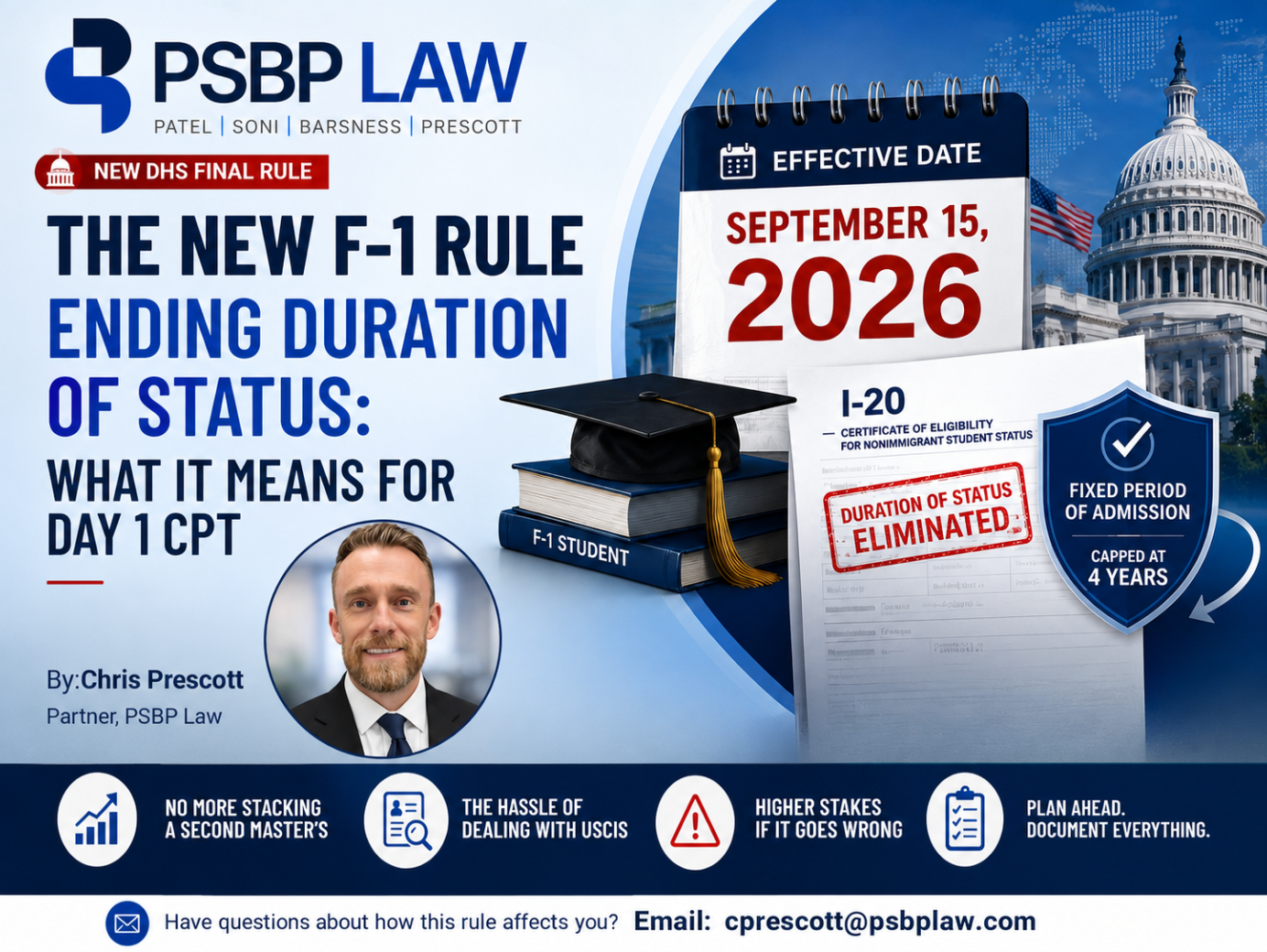
On July 17, 2026, DHS published a final rule eliminating “duration of status” (D/S) for F-1 students and replacing it with a fixed period of admission, capped at four years, effective September 15, 2026. I have written about Day 1 CPT several times over the years:
Why Day 1 CPT Is Not A Good Idea And Can Cause More Problems Than It Solves
Not Selected In The H-1B Lottery? Is Day 1 CPT The Only Option?
Every time I revisit this topic, the conversation eventually lands on the same question: Is Day 1 CPT still a good option? This rule changes that answer and is unfortunately not in favor of anyone treating Day 1 CPT as a long-term strategy.
No more stacking a second master’s
Back in my first article on this topic, I pointed to 8 CFR 214.2(f)(10) and explained that someone who has already used 12 months of practical training on a first master’s degree only becomes eligible for further practical training by moving to a higher educational level, meaning a PhD, not another master’s. That regulation hasn’t changed.
What has changed is that DHS has now built a parallel restriction directly into the SEVIS enrollment framework itself. Under the final rule, a student who has completed a program at one educational level may only begin a new F-1 program at a higher educational level. Programs at the same level, or a lower one, are prohibited outright.
This closes the loophole that most Day 1 CPT enrollments have been built around. The most common scenario I’ve seen for years: a student finishes a master’s, uses up OPT and STEM OPT, doesn’t get picked in the H-1B lottery, and enrolls in a second master’s at a school like University of the Cumberlands or Campbellsville in order to continue working. Going forward, that path is gone. Once you’ve completed a master’s degree, your only compliant route to a new F-1 enrollment, Day 1 CPT or otherwise, is a doctoral program. A second master’s, even a legitimate one in a completely different field, will no longer support a new F-1 enrollment. This will seriously impact those considering day 1 CPT courses.
This isn’t retroactive. Programs you completed before September 15, 2026, don’t count against you. But if the plan was to start a second master’s this fall or next year to keep the Day 1 CPT pipeline open, that plan needs to change now. The only way to remain a viable Day 1 CPT candidate going forward is to be pursuing a PhD.
The hassle of having to deal with USCIS
Under D/S, a DSO could extend a student’s program internally, and USCIS never looked at the file until the student applied for OPT, a change of status, or some other benefit. This means that individuals who switched to a Day 1 CPT course never had to go through USCIS. The DSO at the new Day 1 CPT school simply issued a new I-20 authorizing employment and off they went.
However, under the new rule this is no longer possible. Every F-1 student will now admit for a fixed period, capped at four years. Therefore, someone applying for Day 1 CPT will have to file an extension of status with USCIS, which means a filing fee, biometrics, and a USCIS adjudicator reviewing the file well before anyone gets near an H-1B petition.
I have spent years telling clients that USCIS scrutinizes Day 1 CPT applicants disproportionately at the change of status stage: RFEs asking for proof of class attendance, evidence the CPT is tied to the degree, confirmation of a full course of study. We have gotten the large majority of these approved, but it has never been a rubber stamp, and we have seen denials where the CPT job wasn’t closely enough related to the field of study. Now that same scrutiny gets a second bite at the apple, years earlier, at the extension of stay stage. It’s possible that USCIS may start denying extensions where someone seeks to extend their F-1 status in connection with a Day 1 CPT course, even at the PhD level. However, only time will tell.
The stakes are higher if it goes wrong
The rule also brings back a version of the unlawful presence exposure I warned about in my original 2019 article. Unlawful presence now starts accruing the day after the I-94 expires, not after a formal USCIS or immigration judge finding, unless a timely extension has been filed. Filing on time protects you while the application is pending, but if that extension is denied after the admission period has already expired, there is no grace period, and you therefore must leave the country immediately or risk accruing unlawful presence. The impact of unlawful presence cannot be understated. More than 180 days of that and you are looking at a 3-year bar; more than a year, the 10-year bar.
What this means if you are currently relying on Day 1 CPT
If you are already on Day 1 CPT, figure out your fixed admission end date under the transition rules now generally the later of your I-20 program end date, capped at four years from September 15, 2026. Don’t wait until you are close to that date to plan your next move.
If you haven’t started yet and were planning to use a second master’s as your entry point into Day 1 CPT, that plan no longer works. A PhD is now effectively the only compliant route to a new F-1 enrollment once you have completed a master’s degree.
And plan for the fact that USCIS, not your school’s DSO, will be reviewing your file at the extension stage. Treat that filing with the same seriousness you would an H-1B change of status petition: full documentation of class attendance, a CPT letter tying the job to your field of study, and evidence of a genuine full course of study. Don’t wait for an RFE to start assembling it.
If you are on Day 1 CPT, or considering it, and want to talk through how this rule affects your specific timeline, reach out to me at cprescott@psbplaw.com.